Friday, November 13, 2015

Bear with Me by Ruth Smith Meyer

Me? Hibernate like an animal?  There may be some advantages.
As a child, author Thornton W. Burgess provided a delightful door to the world around me. I often sat, 15 or 20 feet from the ground, in the fork of a big maple tree in front of our home and entered the animal kingdom through his pages. Living with Reddy Fox, Jerry Muskrat, Jimmy Skunk, Cubby Bear and other creatures gave me the sense that I was sharing this planet with many other species. These stories helped me understand challenges that animals face, gave me a glimpse of their homes, the things that threaten their lives and the joy they find in the every day.
I thought of Burgess when our blog moderator asked the question “Hibernation – how come only bears get to hibernate? What would you do if you could go into hibernation?”
There are times when hibernation sounds like a mighty good idea.  Life gets hectic, when the days aren’t long enough to get everything done, or conversely, our attention is so focused on one thing that the other parts of life fade into the background. At such times, to have a season-long snooze becomes quite appealing. 
With my husband in the hospital and in rehab fifty minutes from our house, the past three months have been such a period in my life. There have been nights when I went to bed and thought I could sleep for a month or two, and mornings when I just wanted to burrow further into my bed and ignore the sun that shone through my window.
So if I were to hibernate, what would I like to do?  Starting around the beginning of November, I’d like to let my mind and body rest. The delta sleep with its deep slow brain waves could last for the first month or so.  
Over the years, I have found that I often come up with my best ideas for writing while I am partially asleep. After a time of that delta sleep, I would progress to the REM stage (Rapid Eye Movement) also known as active sleep or paradoxical sleep. I could wake up momentarily to jot down some of the ideas that spring up.  I could then alternate between the two stages. 
Recently, I’ve awakened in the dark of night, already praying for a person or a situation, some of which have been on my mind and others seemingly out of the blue.  During my hibernation it would be nice to have that happen frequently in those REM stages with brief moments of consciousness before falling asleep again.

Sometime, from the end of February to the middle of March, I’d like to emerge from my state of dormancy having had my body burn up most of the excess fat I’ve stored for too long, feeling fit as a fiddle, fired up and ready to get my mid-hibernation jottings in a more complete form on my computer.  Then I could look for places that would be glad to publish my wonderful articles and books.

Ahhh! Cubby Bear move over!


Wednesday, November 11, 2015

Beyond our resources—Carolyn R. Wilker


It’s rare that I go to the movies or even watch one on television, but recently I went to see one at the theatre with a friend, 3-D glasses, giant screen—the whole deal except for the popcorn.
The Martian opens with a group of astronauts on the planet of Mars. The captain decides to abort the mission when a sandstorm comes up and the team is in agreementexcept that one of the six was hit with flying debris, and they believe him to be dead. The remaining crew members leave the planet without him. 
On their return to Earth, the chief scientist at NASA announces sombrely that the crew has returned from the mission to Sol except for the sixth member, Watney (played by Mark Damon). They hold a funeral service for him back home and the other members of the crew go back to their duties. Sometime later, as NASA explores the planet by satellite, they discover movement at Sol and discover that Watney is very much alive, proven when he begins sending messages back to Earth.
The movie is essentially about whether or how NASA can bring him home, and Watney on Mars, figuring out how to survive as an inhabitant of the planet until such a time as he can return home. The astronaut understandably goes through many emotions, from fearing he’ll die there to figuring how he can stretch the resources in the hubble to keep himself alive until the next mission. He uses all the astrophysics laws he knows and all the resources left behind from the failed mission and a previous one too.
My friend Doris said she liked how the different countries worked together to try solve the problem. I appreciated that too, but also that the astronaut team was a mix of men and women and the women had as much input as the men. Another place that stood out for me was the time when all their possible solutions might still fail and one of the men at Mission Control says, “My Mom was a Baptist and my father was a Buddhist,” suggesting that they pray. The head of NASA said essentially, “Whatever works.”
The movie shows how it often works, that we, too, often leave prayer as a ‘last ditch’ effort. It’s good to use our brain for problem solving, as well as the resources available to us, and to accept the assistance of others.
We may not go on a mission as complicated as that fictional one to Mars, but we can pray ‘along the way’ for wisdom and direction as King Solomon did when he began his reign over Israel in Old Testament times (1 Kings 3:7). It might seem that Solomon had as much to manage, in terms of people, complicated relationships, property and conflict, in his time, as astronauts do in our time in a real mission to outer space. Solomon looked over his new kingdom and declared his need of help in governing it.
You need to go and see the movie for yourself. Just remember that, day to day, you don’t have to wait until all your physical resources have been exhausted to pray about a situation.  Pray as you go, asking for wisdom and direction, whatever the challenges might be, ‘cause we all have them.

Carolyn Wilker is a writer and editor from Ontario, Canada.

www.carolynwilker.ca


Tuesday, November 10, 2015

Charles Reaper, Quarrier Boy, last living infantry man from Vimy Ridge by Rose McCormick Brandon

Charles Reaper
Between 1869 and 1939, more than 100,000 children immigrated to Canada from England, Scotland, Ireland and Wales. More than 10,000 of them enlisted for Canada during WWI. That was almost all of legal age and a few that fibbed.
Charles Reaper, a boy who immigrated through Quarriers of Scotland,  was Vimy Ridge’s last remaining infantry man. He died in March, 2003.
At twelve, Charles, a Glasgow orphan, arrived in Canada on April 8, 1912. Four years later, he lied about his age and joined the military. "It was," he said, "the only lie I ever told."
At Easter, 1917, before he turned eighteen, Private Charles Reaper was one of 20,000 Canadian soldiers who formed the "creeping artillery barrage" that took Vimy Ridge.
Decades later, when Charles was interviewed about his Vimy Ridge experience, tears filled his eyes as he recalled the battle that took the lives of hundreds of his fellow soldiers. As his comrades fell around him, there was nothing to do, he said, but to keep moving forward with his unit, over the Douai Plain. Charles was hit by shrapnel. He counted himself
Vimy Ridge Victory
fortunate; 3600 died during that hard-won battle.
Charles spoke little of his war experiences, not even to his wife, but when he did, he always added, "What kept me alive was the man above.” Charles recovered from his Vimy Ridge wounds and by the Fall of 1917, he was entrenched in the third battle of Ypres, on Flanders Fields.
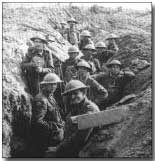
WWI trenchIn trenches filled with mud, his uniform soaked, his body chilled, he survived mustard-gas attacks by pressing underwear soaked in urine over his mouth and nose. Canadian troops prevailed and overtook at Passchendaele, a Belgian village, but not without heavy losses, on both sides - 500,000 soldiers died in that epic battle.
Charles was wounded and sent to a hospital in England for a long recovery. "Because of my accent, they called me an Old Country kid in the hospital," he recalled. "But I said, `No, I'm a Canadian.' "
Though he’d been in Canada only four years, Charles developed a strong sense of devotion to his new country. At the end of the war, he settled in Winnipeg where he worked as a transit supervisor and driver for forty-eight years. After the war, Charles met and married Anna, whom he was married to for sixty-nine years. She said of her husband, “Charles hasn’t talked much about his war experiences, but he has always believed that serving his country was his duty and a glorious moment in his life.”
Charles and Anna had no children but were close to many nieces and nephews. A month shy of the 86th anniversary of the battle at Ypres, Charles Reaper, age 103, died in Winnipeg on March 1, 2003. Charles’ obituary read:
CHARLES REAPER Peacefully at the Riverview Health Centre, on March 1, 2003, Charles Reaper passed away into the arms of the Lord. Left to mourn are his dearly beloved and dedicated wife Anna; his nephew Darren Stirling (Debbie) and Janice Gill (Don) who were always there for him with endless love and kindness. Also many loving family members including numerous nieces and nephews. Charles was born on July 27, 1899 in Keith, Banffshire, Scotland. Charles Reaper, who died in Winnipeg a week ago today, aged 103, was the last of the 20,000 young Canadians who "went over the top" at dawn on April 9, 1917 to attack Vimy Ridge, and by lunchtime had given the young nation its first grip on a fragile national identity.

Promises of Home - Stories of Canada's British Home Children by Rose McCormick Bandon  is a collection of 31 stories of destitute children who immigrated to Canada and worked as indentured servants until age eighteen. Their coming helped to make our country great. Promises of Home, both the book and blog, seeks to give these children the honour they deserve. To purchase the book, visit http://writingfromtheheart.webs.com.
 

Monday, November 09, 2015

Hey Mr Tambourine Man - HIRD


Hey Mr Tambourine Man
By the Rev. Dr. Ed Hird
One of the most romantic dates that my wife Janice and I go on is to the local library.  We are both avid readers.  When I become excited about a new book, I love to read out a section to Janice.  Because she dearly loves me, she will usually put down her own book and give me some quality time.  After a while, Janice will usually say: “Can I go back to reading my own novel because I am right in the middle of an exciting part?”
One of my most exciting finds at the library was a new biography by Ian Bell, entitled “Once Upon a Time: the lives of Bob Dylan”. The Financial Times describes this book as the best Dylan biography yet.”  WB Gooderham of The Guardian, UK described ‘Once Upon a Time as “Knotty, beguiling, contrary, infuriating and as ambitious as its subject, this could be the most vital Dylan biography yet.”  As part of writing this Deep Cove Crier article on Bob Dylan, I have been asking friends, neighbours, relatives and local business people as to what they think and know about Bob Dylan.  I discovered that Dylan has had a remarkably long shelf life, appealing to a wide variety of very diverse people. 
My favorite Dylan song is Hey, Mr Tambourine Man.  No one can ever fully agree to what Dylan means in his mysterious, playful lyrics.  Hunter S Thompson dedicated his book Fear and Loathing in Las Vegas to Bob Dylan because of this song allegedly promoting Mr Tambourine Man as a drug pusher.  Dylan told Joni Mitchell’s husband Chuck that the Tambourine Man was the one common musician in the New Orleans funeral Jazz Bands that helped people grieve the death of their loved ones, and embrace their own mortality.   I see Dylan as an enigmatic Tambourine Man who is playing songs for us in our jingle jangle world. 
The Byrds' version of this song convinced Dylan to switch to rock & roll.Like our Canadian Bruce Cockburn, Bob Dylan is one of the most private, elusive public figures in the world.  The grueling pace of touring and interacting with the media has destroyed many musicians over the years.  Dylan himself often lost himself for a while in the midst of such media onslaught.  As June Sawyers ironically put it in Book List, Dylan is an artist who, to this day, defends his right of “artistic autonomy, refusing to be anyone but himself, whoever that may be. “
Michael Dyer of the Japan Times Newspaper has called Bob Dylan the single most important artist in the history of popular music.  What pains many of Dylan’s fans is that he keeps artistically reinventing himself again and again.  Just when you have ‘figured’ Dylan out, he surprises you.  The real Dylan is always blowing in the wind.  At age 74, Dylan the Tambourine Man will likely reinvent himself many more times before he goes home to the Lord.  You cannot put Dylan in a box.  When Dylan switched from folk to rock, he was publicly booed and called a ‘Judas’.  When he embraced Jesus in the 1980s, many people walked out of his concerts.  Geoff Dyer of the New York Times commented: “The conversion to Christianity was the point at which I, like many others, first jumped ship, but again, bootleg recordings have since made clear that as a result of his newfound faith, Dylan rocked harder than he has ever done since.”  Some people have never been able to forgive Dylan for spiritually reinventing himself.  After Dylan’s explicit spiritual trilogy of albums “Slow Train Coming, Saved, and Shot of Love”, he has become more parabolic and subtle in talking about his faith.  Sometimes less is more.  When I came to faith, some people dismissed my conversion as a phase that I would get over.  My hunch is that Dylan’s coming to faith was more than just a phase.  Dylan the Tambourine Man, far from the twisted reach of crazy sorrow, is continuing to enable us ‘to dance beneath the diamond sky with one hand waving free, silhouetted by the sea, circled by the circus sands.’
Back in 1976, The American Guide magazine asked Dylan how he imagined God.  He memorably said: "I can see God in a daisy. I can see God at night in the wind and rain. I see Creation just about everywhere. The highest form of song is prayer. King David's, Solomon's, the wailing of a coyote, the rumble of the earth. It must be wonderful to be God. There's so much going on out there that you can't get to it all. It would take longer than for ever.”
I am struck by how deeply the African-American churches have embraced Dylan’s Gospel music.  Blues and Folk music have deep roots in the African-American community.  While other people may have been offended by Dylan’s Gospel music, the African American churches have transformed these songs into large choir productions.  Even if Dylan never again writes such explicit Gospel music, I believe that his Gospel songs will continue to impact many new generations.  Music has a way of outliving its composer, even Dylan. 
I thank God for Bob Dylan the Tambourine M an who continues to fascinate so many of us.  Through his evocative songs, he takes us ‘down the foggy ruins of time, far past the frozen leaves, the haunted, frightened trees, out to the windy beach.’  Only God really knows Bob’s heart.  Our calling is to enjoy his music and remember to pray for him and other musicians.  There are few tougher callings than that of a travelling Tambourine Man   . 


The Rev. Dr. Ed Hird, Rector
-author of Restoring Health: body, mind and spirit and Battle for the Soul of Canada


Sunday, November 08, 2015

Down with the selfie! Let's be groupies! - Denyse O'Leary

This story originally appeared at MercatorNet .
The infamous Nelson Mandela memorial service selfie: Danish prime minister Helle-Thorning
Schmidt flanked by David Cameron and Barack Obama. Roberto Schmidt/AFP/Getty Images

At the New Yorker, Adam Gopnik attempts a nuanced defense of the “selfie,”
The usual complaint against the selfie is that it substitutes terrible narcissism for what once was a sense of seeing things for their own sake—that what matters to the eye of the iPhone camera is not the place I am in but the fact that I am in it. The need to memorialize the moment takes precedence over living the actual experience. But have we not always been inclined to “take” our faces to preserve our upbeat moments?
Yes, but it was never so easy to make every possible event, even a memorial service for someone else, a chance to celebrate—oneself. Indeed, when President Obama and other world leaders did that at Nelson Mandela’s memorial, many media types hastened to defend them.
In the age of the imperial self, it seems, one markets oneself, often to oneself.
All that said, if we do not want merely to star in our own reality show 24/7, cell photos can help us maintain relationships over time and distance.
For example, my family has found informal cell pix helpful when visiting very old seniors who live in retirement homes and can’t travel much or have memory problems. We print them out, label them, and show them to the resident. Perhaps the one we took yesterday of themselves with their great grandchildren. We put them up on the door to be admired by nursing staff and other visitors. The resident is then constantly reminded of the people who visited, who they are, and why they were there.
Or one can send photos of the interior of a newlywed grandchild’s new home, thousands of kilometres away, to the tablet in Grandma’s room. Regular photos of a pet, now cared for by someone else, can supplement occasional pet visits.
As an aside, some seniors complain bitterly that they have been separated from a beloved furry companion. At some level, most realize that the animal is better off living with a younger person who can easily provide care and exercise. Cell pix would make it easier to stay in touch with how the pet is doing between visits.
Readers, can you share ways you use quick photos to help people stay in touch with each other in the comments box?
Here are commonsense tips from collections of selfie etiquette:
– From About Etiquette:
Be respectful. If you are at a holocaust museum, taking a selfie in front of an exhibit shows a lack of respect for those whose lives were lost in this horrific era. People's emotions are still raw over what happened, and they are likely to be that way for centuries. There are places where selfies are never appropriate, including a funeral, ICU or critical care unit in a hospital, and disaster site where people died. 
Although we might take for granted that anyone would realize that, we recently looked at the extensive efforts that one young woman had to undertake to recover her reputation and career after an ill-advised selfie at a military cemetery.
– This hardly needs sayng but one should never publish an identifiable image of a person captured in the photo without their permission of course. Apart from invasion of privacy, if that person is sick, injured, or distressed, it is callous.
– We should all bear in mind that the internet can be forever, especially for the very things we might wish to lose.

Denyse O’Leary is a Canadian journalist, author, and blogger.

Friday, November 06, 2015

On Being Vulnerable

I've been watching TED videos of Brene Brown on vulnerability. Like her, the thought of opening up some of the secrets of my heart to another person is scary. I love the part of her second TED talk when she shares how she told her friend she had a vulnerability hangover from telling 500 people she had a breakdown. Little did she know that original TED video would be viewed over 20 million times.

The very definition of vulnerability causes us to pause before we risk.

Vulnerable: susceptible to physical or emotional attack or harm.  

It's human nature for us to be protective of ourselves. The world is a dangerous place. People talk about you so sharing your personal information with others - which can be held against you - makes you hesitate. You dare not overshare on social media lest you are mocked and someone comments "TMI" (too much information)  on your post. Even your employer might decide they don't need you anymore if you openly share too much.

You see, all sorts of terrible things can happen when we allow ourselves to be open and vulnerable.  However, when we protect ourselves too much, we can miss out on all the wonderful things that can happen when we open up and become vulnerable.

One of the teachings of Jesus that always speaks to me is in Matthew 18. When the disciples asked about who is the greatest in the kingdom, Jesus calls a little child over and says,

"I assure you that if you don't turn your lives around and become like this little child, you will definitely not enter the kingdom of heaven. Those who humble themselves like this little child will be the greatest in the kingdom of heaven." 

That's right, vulnerable like a little child. One who needs protection, one who is genuine,  has a sense of awe, one who is trusting and who loves easily, sharing their heart.

He demonstrated it for us many times and one that particularly stands out to me is when he was in the Garden of Gethsemene. He asked his disciples to stay awake with him. Listen to the words in the CEB translation:

"Then Jesus went with his disciples to a place called Gethsemane. He said to the disciples, “Stay here while I go and pray over there.”  When he took Peter and Zebedee’s two sons, he began to feel sad and anxious. Then he said to them, “I’m very sad. It’s as if I’m dying. Stay here and keep alert with me.”

You can hear the vulnerability in his words. He opened himself up and let himself be vulnerable. Not to everyone, but to those who were closest to him. Our relationship to God depends on our openness and vulnerability. We come to him and lay it all bare before him and he takes that offering of ourselves and makes us his children.

When we open up our hearts to each other, the same thing happens. Our relationships become special and deep and rich.  “Vulnerability is the birthplace of innovation, creativity and change” according to Brene Brown. And for those of us who follow Jesus and want to live like him and for him, we need to break down the barriers we erect in order to do just that.

Much grace...Kathie


Major Kathie Chiu
Pastor - Richmond, BC
www.kathiechiu.com
#nanaslife

Monday, November 02, 2015

A Bit o' Heaven on Earth (Peter Black)


My Beloved and I finally broke free from the heavy, slow molasses that clung to and characterized our driving experience through much of Toronto on Highway 401, as we headed east. Multi-story towers diminished in number, and eventually the box-like sameness of sprawling condominium developments and modern cheek-by-jowl homes yielded to the welcome sight of nature’s autumn colours in glorious profusion.

This would be our first visit to the “The King’s Town” – Kingston, Ontario – in ten years. We’d moved away from there thirty years ago.

Kingston Ont. Murney Tower
We’d decided that during 2015 we would drop in quietly and unannounced at each of the churches we had served during the years of our pastoral service. The project was all but completed, except for Kingston. We left that to the last, since Kingston was the furthest away from home.

During our almost five years of living there in the early 1980s we met some memorable characters. Among them was Bob. A former penitentiary inmate, his life had gotten turned around by the grace of God during his incarceration. Following his release he attended our church for some time and married Lisa.

One of Kingston, Ontario's Marinas
While becoming established in following Jesus consistently, Bob continued developing his graphic arts and crafting skills. These days he’s busy working on his custom metal-work creations.*
His popular hand-crafted belt buckles are mailed to many countries around the world. He and Lisa have developed a home-based business, and continue in their walk of faith with Jesus.


"Nigerian Girl"
Fine art by Robert Aucoin
See website URL below.
Several years ago Bob and I had been in touch by phone and email, at which time he gave me express permission to publish his real name (instead of a pseudonym) in a newspaper and a magazine article, and also to include a print of his stunning pencilled portrait titled, “Nigerian Girl” (see pic).
He later extended the permission to include both an edition of the article and the portrait in my book, “Raise Your Gaze . . . Mindful Musings of a Grateful Heart” (see below). However, until my wife and I made our recent trip we hadn’t actually seen the couple in more than thirty years.

We really hoped to see them again, but didn’t want to inconvenience them or have them change any plans they might have. And so, while in the city I phoned to say that we were in Kingston for a couple of days and would very much like to see them. Wonderful! They and their daughter were home and gave directions to their beautiful lakeside community, some kilometres outside the city.

News from across the years flowed freely. It was a marvellous time of catching up on
Bob & Lisa.
(Sorry: I've lost resolution along the way.)
 our respective families and the joys and challenges that the Lord had brought us all through. May and I sensed deep grace and trust in the couple’s lives, and our hearts felt truly blessed by their warmth towards us.
An added bonus was in our meeting Lisa’s 94-year-old mom. This bright, cheerful lady insisted on getting out on a chilly day to mark her ballot in the Federal Election, despite having a fractured back.

The vivid autumn hues on our drive up from Kingston to our friends’ idyllic surroundings by the lake, while truly impressive, were outshone by our visit and fellowship.
Heaven kissed earth for us as Bob and Lisa welcomed us into their home amidst hugs, handshakes and greetings, after all these years.
 
It was truly a little bit o’ heaven on earth.

~~+~~
Robert Aucoin’s website: *www.ironartcanada.com
~~+~~
The above post is a modified edition of an article published in Black's column, P-Pep! in The Standard Guide Advocate, October 29, 2015.
~~~

Peter's second book is a compilation of inspirational articles on a variety of themes from his weekly column. These are interspersed with brief expressions intended to encourage. Ebook edition is available through Amazon.
 
ISBN: 978-0-9920074-2-3 (Angel Hope Publishing)
 
Peter's first book: “Parables from the Pond” – a children's / family book (mildly educational, inspirational in orientation, character reinforcing). Finalist – Word Alive Press. ISBN: 1897373-21-X. The book has found a place in various settings with a readership ranging from kids to senior adults. Black's inspirational column, P-Pep! appears weekly in The Standard Guide-Advocate (of Southwestern Ontario). His articles have appeared in 50 Plus Contact and testimony, and several newspapers in Ontario.
~~+~~


Sunday, November 01, 2015

Water Delivery - Eleanor Shepherd

           
It was a Wednesday morning, the day when there is usually the least number of employees present at the church.  Just before 8:30 the doorbell rang, and I went down to see who was there.  It was unusual to have people coming to the door that early.  It was the man from the bottled water company who provides the water for our water coolers.  Usually he comes later in the day, but they happened to be passing that morning and thought they would see if anyone was there so they could make their delivery.

           
We headed to the elevator together and went up to the first floor where we store the new bottles, so we could check on the empties.  He brought two bottles with him, knowing from experience that we would need at least that many.  A few weeks ago he told me that each of these bottles of water weigh 45 pounds, so carrying 90 pounds of water, it made more sense to take the elevator than the stairs.  As we go up and down together in the elevator we usually have a conversation.  My problem is that although I am fluent in French, I have a great deal of difficulty understanding his accent, and my guess is that he has as much trouble understanding mine.  Often, I make sounds to indicate agreement, even though I am not exactly sure what it is I am agreeing with, and I hope that I am not making a complete fool of myself.  What further complicates our conversation is that he mumbles as well, so that even if I understood the words he was saying, I cannot really quite hear them.


            That Wednesday morning, we had one of our typical conversations, about the whether and life in general, with me hoping that what I heard and said was in some way relevant to the conversation.  We had a couple of trips up and down in the elevator, as he needed to bring up another couple of replacement bottles.  Then when he finished his delivery, I signed the electronic pad that he gave me with the stylus provided and he headed for the elevator to leave the building.  As he did so, he said clearly to me in French, "May the good Lord watch over you today."  The words were well articulated and I understood every one of them and I automatically responded in French, "And may He watch over you as well." Then he was gone.

            What immediately came to my mind were the words of my husband, during the prayer that we had together before leaving the house after breakfast that morning.  He prayed that we might be aware of God at work in the lives of others who might cross our paths that day.  


            It struck me as rather ironic.  Here was I, the pastor, receiving these words of blessing from the man who delivered our water.  Perhaps there was more going on here than I realized.  How symbolic is it that Jesus so often referred to water.  When He spoke of the Holy Spirit, He identified Him as a source of living water that would spring up in us.  As I reflected on this brief encounter, I knew that Glen's prayer for me that morning had been answered.     
Word Guild Awards
2011
Word Guild Award
2009


Thursday, October 29, 2015

The Predictability of Change - Donna Mann


I recently overheard someone refer to the fall colours as 'God's bouquet of colour.' I couldn't agree more. 

This year has been a splendid colourful year especially for the Ontario reds. It has been like a pageant with the various trees changing frocks when the sun shone from different dimensions. 

The trees have gone through a process of fully submitting to reds, yellows, and oranges. Complete hardwood bushes changed before our eyes as if a master painter had taken a broad-brush stroke and spread multiple shades across its branch tips.
But, there is still another surprise. As bare trees stand tall across the horizon, splashes of deep green have begun to protrude across the landscape: single evergreens, here and there, perhaps not as conspicuous as they grew among the tall colourful trees, but now they gain a natural recognition. What a find!
The seasons teach us wonderful lessons of life. It is in the dying that the leaf takes on the vibrant colours of beauty. It is experiencing the bitter frigid frost that the soft summer greens surrenders to the luxurious artwork of the fall.

It is in letting go of one season that trees can totally enter into another. It is in the loss of one splendour that another beauty is discovered. Changes in the seasons bring about changes in the scenery. Transformation only happens as one life cycle lives out its purpose and is open to the next one.

In some ways, my life is like the leaf. Some area of it is constantly dying so that new life may happen in another area. Predictable changes bring about transformation. Unexpected circumstances create indelible marks on life. Expected flows of life create colourful results. Seasons of grief birth goodness of life. There is balance, there is beauty, there is hope that the world is unfolding as it should and there is a loving Creator at work in nature as well as human nature. (Revised from Seasons of The Soul, DJM)

(Today, I attempt to post on my roster date. Resting my broken right hand on the arm rest, I am aware that the change in my daily life is predictable as well. Action and consequence teach many good lessons.)

Blessings
Donna 

www.donnamann.org

Tuesday, October 27, 2015

The Curiosity - Tracy Krauss

Curiosity:


a) the desire to learn or know about anything; inquisitiveness.
b) a rare, or novel thing.


c) a strange or interesting quality


Writers are curious people by nature, I think, and I don't just mean inquisitive. I'm referring to the 'strange' part in the third definition.

Think about it. Who else but a 'curiosity' would willingly admit to the following?

1. I shut myself off from reality in order to create a different reality of my choosing.
2. I 'hear' voices in my head.
3. I carry on conversations with imaginary people.
4. After months or even years of pouring myself onto the page, i allow other people to pick it apart.
5. My hourly wage for labor would be in the fractions of a cent.
6. The odds of making enough money to actually live on are astronomical but I keep trying anyway.
7. Sometimes I feel tired and discouraged and stuck and sick-to-death-of-writing-so why-bother-because-I'm-no-good-anyway... but I keep going back to it like a dog with a bone.

The list just gets curiouser and curiouser... I could go on but I think I've made my point. All hail to the curious breed known as 'writer'. May you never give up your dream. (Because you really couldn't, even if you tried.) 

Tracy Krauss continues to 'live the dream' at her home in Northern British Columbia. Visit her blog for more about her curious writing habits, or see her website for her extensive list of published novels, plays, short stories and non-fiction. 

Popular Posts