Showing posts with label Queen Victoria. Show all posts

Tuesday, September 10, 2019

General William Booth: the Fire and the Blood -HIRD


By Rev. Dr. Ed & Janice Hird
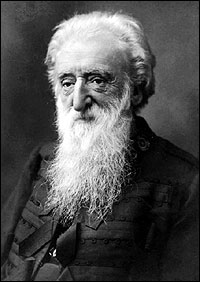
 Image result for william booth

Everyone nowadays loves the Sally Ann, the Salvation Army. But such admiration was not always universal.  Violence and bloodshed was the order of the day when William Booth first reached out to the down-and-out in East London.  Few people today realize that one of the main purposes of the famous Sally Ann Bonnet was to protect the heads of wearers from brickbats and other missiles.  So many people used to buy rotten eggs to throw at the Sally Ann Bonnets that these rancid eggs became renamed in the market place as ‘Salvation Army eggs!’ In fact Janice’s great grandfather George Morgan was a longshoreman who volunteered as a body guard for William Booth, and Ed’s step-great grandmother Ensign Kate Lee Gathercole preached on the volatile streets alongside her good friend Catherine Booth.

In 1880, heavy sticks crashed upon the Salvation Army soldiers’ heads, laying them open, and saturating them in blood.  Mrs. Bryan (wife of the Captain) was knocked down and kicked into insensibility not ten yards from the police station, and another sister so injured that she died within a week.  During 1882, it was reported that 669 soldiers and officers had been knocked down, kicked or otherwise brutally assaulted, 251 of them being women and 23 children under 15.  In Hamilton, Ontario, the Salvation Army officers were initially ‘squeezed and mangled, scratched, their clothes torn and almost choked with the dust…’  In Quebec City, 21 of the Salvation Army soldiers were seriously injured, an officer was stabbed in the head with a knife, and the drummer had his eye gouged out. In Newfoundland, the Salvation Army was attacked with hatchets, knives, scissors and darning needles.  One night, a woman-Salvationist in Newfoundland was attacked by a gang of three hundred ruffians, thrown into a ditch and trampled on.  She managed to crawl out only to be thrown in again, as other women were shouting ‘Kill her! Kill her!

Ironically many police initially blamed the Salvation Army for being persecuted.  In numerous parts of England, playing in a Salvation Army Marching Band was punishable with a jail sentence!  During 1884, no fewer than 600 Salvationists had gone to prison in defense of their right to proclaim good news to the people in music and word.  In Canada alone, nearly 350 SA officers and soldiers served terms of imprisonment for spreading the gospel.  Despite the jail sentences and persecution, within three years the Army’s strength more than quadrupled!  The early Salvation Army ‘jailbirds’ described their handcuffs as heavenly bracelets.  It is little wonder that the Salvation Army eventually developed such a powerful prison ministry. 

One of William Booth’s mottoes was ‘go for souls and go for the worst!’  A local English newspaper The Echo commented that the Salvation Army largely recruited the ranks of the drunkards and wife-beaters and woman home-destroyers.  Many of us remember as children the song: ‘Up and down the City Road, In and Out the Eagle; That’s the way the money goes, Pop goes the weasel’!   Few of us realized that we were singing about the famous Eagle Tavern, just off City Road in London.   ‘Pop goes the weasel’ was cockney slang for the alcoholic who was so desperate for a drink that he would even pawn (pop) his watch (weasel).  Ironically, the Salvation Army bought the Eagle Tavern and turned it into a rehabilitation centre.  The Lion and Key public house in East London became known as ‘The Army Recruiting Shop’.  The landlord said, ‘My trade’s suffering, but you’re making the town a different place, so we can’t grumble.  Go on and prosper!’

William Booth shocked the world by conducting worship with tambourines and fiddles, instead of the traditional church organ.  To make up for the Salvation Army’s lack of church buildings, General Booth bought circus buildings, skating rinks, and theatres.
In response to such bold innovation, one newspaper columnist claimed in 1883 that ‘The Salvation Army is on its last legs, and in three weeks it may be calculated it will come to an end.’  In the beginnings, the Salvation Army was essentially a youth movement, with seventeen-year-olds commanding hundreds of officers and thousands of seekers.  Archbishop Tait of Canterbury was so impressed by this youth movement reaching the poor, that he set up a commission which unsuccessfully tried to adopt the Salvation Army as an Anglican society.

By persevering, the Salvation Army began to earn respect from both the churched and the unchurched, and from all segments of society.  Even Queen Victoria at Windsor Castle sent the following message: ‘Her majesty learns with much satisfaction that you have with other members of your society been successful in your efforts to win many thousands to the ways of temperance, virtue, and religion.’  By their persevering in reaching out to the poor, William Booth and the Salvation Army became known as the champions of the oppressed.    Like no other individual in nineteenth-century England, General Booth dramatized the war against want, poverty and destitution. 

It was not by accident that William Booth’s message became linked with ‘soup, soap, and salvation’!  Every Salvation Army soldier was taught from the beginning to see themselves as servants of all, practicing the ‘sacrament’ of the Good Samaritan.  The famous preacher Charles Spurgeon once said, ‘If the Salvation Army were wiped out of London, five thousand extra policemen could not fill the place in the repression of crime and disorder.’ In recognition of his incalculable impact on the poor, William Booth received on June 26th 1907 the degree of Doctor of Civil Law from the University of Oxford.

William Booth throughout his life showed remarkable creativity and courage.  He was one of the world’s greatest travelers in his day, visiting nearly every country in the world.  Even at age 78, General Booth was described as ‘…a bundle of energy, a keg of dynamite, an example of perpetual motion.’  A keen observer of the international scene, Booth in 1907 prophesied Japan’s technological rise, saying: ‘It is only a question of time when her industries will be tutored with the most expert direction, and packed with the finest machinery taken from all nations of the world, and I do not see what can prevent her producing the finest articles at the cheapest possible price.’

His fellow soldiers saw Booth as a man to follow to their death, if need be.  William Booth was truly a spiritual father to the fatherless.  His son Bramwell held that his Dad’s greatest power lies in his sympathy, for his heart is a bottomless well of compassion.  A Maori woman described William Booth as ‘the great grandfather of us all – the man with a thousand hearts in one!’  Mark Twain said, ‘I know of no better way of reaching the poor than through the Salvation Army.  They are of the poor, and know how to get to the poor.’

We give thanks for the remarkable General William Booth and the Salvation Army who have shown the true Father’s Heart to so many hurting, fatherless people.
Image result for william booth

The Rev. Dr. Ed and Janice Hird


Monday, July 09, 2018

Dr Livingstone I Presume - HIRD


By Rev Dr Ed and Janice Hird
While recently teaching on marriage in East Africa to tens of thousands, we asked many Africans what they thought about Dr David Livingstone. It was encouraging to learn how fondly he is remembered in Africa. Some other westerners may have come to exploit, but Livingstone came to bless and set free people free from their chains.  Livingstone prayed: “God, send me anywhere, only go with me. Lay any burden on me, only sustain me, and sever any tie in my heart except the tie that binds mine to yours.”
Dr Livingstone was one of the world’s greatest medical missionaries, explorers and abolitionists. He originally trained as a doctor in order to reach China with the gospel.  When that door closed because of the opium wars, God opened another door to Africa, starting in Cape Town. Having received the Royal Geographic Society’s highest golden medal, Livingstone lived in an era where no occupation was more admired than that of an African explorer. It had the mystique of a modern-day astronaut boldly going into unchartered territory. Travelling, said Livingstone, made one more self-reliant and confident. He only wanted companions who would go where there were no roads. His books were bestsellers and his lectures standing room only. Crowds mobbed him in the streets and even in church. One poll showed that only Queen Victoria was more popular than the beloved Livingstone.
Many chiefs heard through Livingstone for the very first time of Jesus’ amazing love.  One chief Sekelutu was drawn to Livingstone, but afraid to read the bible in case it might change his heart and make him content with just one wife. 
Livingstone literally filled in the map of Africa, exploring all of its main rivers, covering 29,000 miles, greater than the circumference of the earth. One of his most famous discoveries was the Victoria Falls, named after Queen Victoria, on the Zambezi river.  During his extensive travels, he suffered over twenty-seven times from attacks of malaria, being reduced at one point to ‘a mere skeleton’.  His dear wife Mary tragically died from malaria while traveling with her husband in Mozambique.
Livingstone had been lost for five years in Africa and presumed dead by many. An American journalist Morton Stanley was sent by the New York Herald in 1871 to Africa to rescue Livingstone. 236 days later, after a seemingly hopeless search, Stanley found him, uttering the immortal words “Dr Livingstone, I Presume.” His discovery was voted the greatest 19th century newspaper story. Stanley called Livingstone “...an embodiment of warm good fellowship, of everything that is noble and right, of sound common sense, of everything practical and right/minded...”  Speaking to the 57 men carrying supplies to Livingstone, Stanley said: “He is a good man and has a kind heart. He is different from me; he will not beat you as I have done.” Queen Victoria went out of her way to thank Stanley for discovering Livingstone, said that she had been very anxious about his safety.
Livingstone called the Slave trade the open sore of the world, believing that opening up trade routes would eliminate the Slave trade. His on-location report of 400 slaves massacred by slave traders at Nyangwe was key in ending the slave trade. He mistakenly thought that discovering the source of the Nile would open up trade routes for Africans, ending their dependence on the slave trade.

Livingstone was passionate about the Kingdom, praying:  “I place no value in anything that I may possess except in relation to the Kingdom of Christ. I shall promote the glory of Him to whom I owe all my hopes in time and eternity.” Though his body was buried at Westminster Abbey in London, his heart was buried in Africa, because his heart was full of Jesus’ love for the African people.  My prayer is that we too in Canada may have Jesus’ heart of love for Africa.
 -An article for the July 2018 Light Magazine

Friday, August 14, 2009

The Irreplaceable Sandford Fleming-HIRD

By Rev. Ed Hird+

Recently I dropped over to my friend Keith Cameron who had inspired the ‘Captain Robert Dollar’ article. Keith was so pleased by the Deep Cove Crier article that he gave me another tip: “Write about Sir Sandford Fleming, a Scottish Canadian. Fleming was a thinking renaissance man, organizing time for the world. Fleming was a man’s man, bold and adventurous”

When I ask many people about Sandford Fleming, they are tempted to confuse him with Alexander Fleming who discovered penicillin. At age 17, Sandford Fleming emigrated to Canada from his hometown Kirkaldy in Scotland.

Sandford Fleming’s remarkable discovery was time, Standard Meridian Time. In the 19th Century, there were 144 different time zones in North America. Every city was its own Greenwich, having its own personal time zone. As Clarke Blaise put it, “Every self-respecting town on the continent had a right to its own newspaper, its own baseball or cricket team, and its own individual time.”

Sandford Fleming served as the Chief Engineer and Surveyor for the Canadian Pacific Railway. He was an amazing visionary, first proposing a sea to sea railway in 1858, well before people would take him seriously. Several top Canadians told Fleming that since Canada already had sixteen miles of railway, there was no longer a need for engineers! He should just go back to Scotland. A few years later, Fleming became the sole engineer to oversee the survey for the Intercolonial Railway linking the Maritimes to Quebec. As an engineer, Fleming loved anything to do with engines and railways. .

Railway engines brought unimaginable new speed to the vast land of Canada. They also brought new disasters when locomotives crashed into each other because of different time clocks. Sandford knew that it was time to figure out what time it really was. Going to the UK to argue for standardized time, he was snubbed and not even allowed to present his scheduled paper. Jealousy between European nations for a long time paralyzed initiatives to make Greenwich Time the standard time around the world. Sandford showed remarkable perseverance in bringing us the Standard Time that we now take for granted. As Hugh MacLean put it, “Fleming never knew when he was licked.”


Sandford was there at the 1864 Charlottetown Conference which birthed the nation of Canada. He was there for the Last Spike at Craigellachie in November 7th 1885 when Canada was joined by rail from sea to sea. Sandford Fleming has been called ‘the outstanding Canadian of the nineteenth century’.


Where would Canada be today without dedicated engineers like Fleming? Engineers have built Canada from the ground up. Clark Blaise comments: “The engineering profession, always a high calling – and often a source of profound despair – for Fleming, is the link between science and society. The engineer calculates the cost of change, understands debentures and interest rates, the politically possible, the socially beneficial. He reads the future.” As a person of faith, Fleming saw the Engineering profession through the eyes of Isaiah 40 which talked about every valley being exalted: “It is one of the misfortunes of the profession to which I am proud to belong that our business is to make and not to enjoy; we no sooner make a rough place smooth than we must move to another and fresh field, leaving others to enjoy what we have accomplished.”

In 1872 Sandford and his good friend the Rev. George Grant led an expedition to BC in order to survey the future Canadian Pacific Railway. The travelogue they wrote about their adventures became a Canadian best-seller. Both Sandford and George shared a deep Christian faith that sustained them through many trials and tribulations. Wherever Sandford went, he always found time to worship on Sundays, even if it was simply kneeling by the railway tracks and giving thanks to Almighty God. Sandford even wrote a simplified worship service that travellers and busy construction crews could use.

Sandford was always inventing. He created Canada’s first postage stamp, the three-penny beaver. In 1849, he founded the Royal Canadian Institute which became the Royal Society of Canada, a leading scientific institute. He wrote twelve books and served as Chancellor of Queen’s University for thirty-five years. Despite enormous opposition, Fleming built the world’s first sub-Pacific cable bringing instantaneous communication around much of the world. It was for this amazing feat that Queen Victoria knighted Fleming in 1897.

My prayer for those reading this article is that we too like Sir Sandford Fleming may be creative, persevering, and ground-breaking.

The Reverend Ed Hird+
Rector, St. Simon’s North Vancouver
Anglican Coalition in Canada
http://www3.telus.net/st_simons
-published in the September 2009 Deep Cove Crier

Popular Posts