Monday, September 09, 2024


Carson Pue: Characteristics of a good leader

carson pue article

Dr. Carson Pue has been investing in Greater Vancouver leaders and many others for 33 years now.  He was inspired by Billy Graham’s brother-in-law, Leighton Ford, to commit his life to making a difference in the lives of leaders. The result has been seen through Arrow Leadership, and how it has refined the mission and ministry of over 1,200 leaders. Pue notes: “Leadership is lonely. Many leaders find that their “toolbox” is empty. Many of these leaders need to be loved, to be appreciated, and be reconnected in their inner life with Jesus.” As a mentor of leaders, Pue’s passion is for iron to sharpen iron in a community context: “We’re trying to practice our unique calling in our distinctive context, following how Jesus discipled people. It was a combination of actions and teachings happening at the same time.”

Character is at the heart of good leadership. Too often Pue has found that gifted speakers are not always people of integrity.  They get limited support and can be, at the same time, prematurely promoted beyond their level of maturity, resulting in increased potential to fail, dramatically crashing and burning.  

With Brenda, his late wife, he formed Quadrant Leadership, based on the sailing metaphor. Both Brenda and Carson were sailors. His passion is to come alongside leaders as they handle the rigours of the open seas, helping them to be led more by Jesus, lead more like Jesus and to lead more to Jesus.  Pue has spent years developing leaders in a wide variety of businesses and not-for-profit charity entities. His expertise is in high demand locally and internationally by prestigious organizations, enterprises, and institutions. He has served on boards and with executives at World Vision, Kurumbuka Leadership Solutions Foundation (Rwanda), Trueface (Atlanta), Opportunity International, The Billy Graham Center, YesTV (Toronto), and Troyer Industries (Oil and Gas sector).

Recently, Pue produced a year’s worth of Mentored Podcast with the late Dr. Martin Sanders, founder of Global Leadership Inc. These online podcast sessions have become a robust resource, sharing with its listeners many themes that highlight effective mentoring of leaders.

Pue is the bestselling author of Mentoring Leaders: Wisdom for Developing Calling, Character and Competency. His upcoming book Leading Like a Saint is based on leadership principles from Saint Patrick.  Known for his masterful storytelling and innovative leadership style, Pue exposes and equips audiences with many remarkable and fascinating untold stories and principles behind what it takes to be a leader. His interests include sailing, public speaking, reading, music, writing, family and all things Irish! He lives in Vancouver with his second wife, Glenda, and their dog, Murphy. Carson takes great joy in spending time with his three sons, their wives – who he affectionately refers to as his “daughters” – and his seven grandchildren.

Pastor Scott Anderson, Lead Pastor of Lambrick Park Church, Victoria commented: “Carson has been personally influential in the formation, renewal, and encouragement of an extraordinary number of leaders in many sectors (health care, relief and development, business, finance, govt, etc). I think it’s fair to say that the church of Jesus Christ is seeing significant fruit today because of devoted leaders like Carson Pue.  I know I am.”

Bob Kuhn, a lawyer, consultant, past president of Trinity Western University and Carson’s longtime friend, recognized the tremendous benefits of Pue’s advice and wisdom when Kuhn asked him to serve on Trinity Western University’s executive leadership team as Special Assistant to the President. While Kuhn sought to lead key growth and creative leadership to the University during the six years of particularly challenging conflict, “Carson was not only a fully grounded, wise and an ideal voice of mission-refinement at TWU, he was strong, caring and totally reliable as he took on roles that required a critical, mission-sensitive but caring skill set. I don’t think I could have taken on the leadership demands of Trinity’s president during those years without him.”

Carson Pue will be speaking at the 39th White Rock/South Surrey Leadership Prayer Breakfast on Friday, Oct 25, 2024, 7 to 9 am at Peace Portal Alliance Church in South Surrey. 

About Rev. Dr. Ed & Janice Hird

Ed & Janice HirdBooks by Rev. Dr. Ed & Janice Hird include God's Firestarters; Blue Sky, a novel; and For Better, For Worse: Discovering the keys to a Lasting Relationship. Dr Ed’s newest award-winning book The Elisha Code is co-authored with Rev. David Kitz. Earlier books by Dr. Ed include the award-winning Battle for the Soul of Canada, and Restoring Health: Body, Mind, & Spirit.

Monday, August 19, 2024

When Others in Need Come to Mind


This week, as I write, people in the town of Jasper were allowed to “come home” and assess damages. They had a one-hour time frame to be there as the fire still raged some distance away.

Imagine coming back to your town to see your lot empty. No house where it once stood, shiny and clean, but now a grey dusty patch over perhaps a cement foundation. Bare earth where grass once grew. Everything gone! And if you drove as far as the park, the road into it was a charred mess of black sticks, all that’s left of a once beautiful forest.

I watched the online video. Section after section of homes burned to the ground. Some homes and businesses sustained less damage, but the town was rather empty, aside from RCMP and a small contingent of staff.

Interviews with people who’d lived there, or had planned to, showed a mix of people who wanted to come back and start over. Others planned to move somewhere else. One of those people interviewed was a leader in the town, a daughter of a retired writer I know.

Wendy had just started a new job there and her mom wondered how often that kind of job comes around. In our messenger conversation, I said I was glad they got out safely. But what about work? One needs a job in order to live. I promised I would pray for her daughter and family.

My own resources may be limited to a small donation at times like this, but God is bigger. Not diminishing the need for many of these families, I pray that they will get the help they need to get back on their feet and be able to earn a living again. I pray when Wendy and that community come to mind. It certainly isn’t hard, since they are in the news as much as the war in the middle east.

What can we do? Pray! Sometimes it’s all we can do, and let the people know we are praying for them.


Saturday, August 10, 2024


Archbishop Thomas Cranmer, shaper of the Anglican Way

-an article for the Light Magazine

By Rev. Dr. Ed & Janice Hird


If you have ever been to a wedding service, you can thank Archbishop Thomas Cranmer for his contribution of these new words:  ‘to love and to cherish.’ Cranmer beautifully translated from the Latin Sarum rite these now familiar vows: “to have and to hold from this day forward, for better, for worse, for richer, for poorer, in sickness, and in health, to love and to cherish, till death us depart.”  He had a liturgical gift, a poetic ability to develop English-language worship services, marriage services, and funeral services that still speak to people over five hundred years later. 

Cranmer birthed an English Reformation that was not only the via media (middle way) between Catholic and Protestant, but also the via media between Luther and Calvin.  Cranmer was not the first Archbishop of Canterbury, but rather the 67th and the first Protestant Archbishop of Canterbury. As of today we have had 105 Archbishops of Canterbury. The Anglican Church was not created by Cranmer, but rather reformed and renewed. He has been described as the most mysterious person in the English Reformation.

Born in 1489 at Aslockton Nottinghamshire, he was sent at age 14 to Jesus College, Cambridge after the death of his father.  During his Master's degree, Cranmer studied the Renaissance humanists, Jacques Lefèvre d'Étaples and Erasmus. Shortly after receiving his Master of Arts degree in 1515, he was elected to a Fellowship of Jesus College. Many are unaware that Cranmer had initially been kicked out of Cambridge University in 1515 for the ‘sin’ of getting married.  To support his new wife, he worked as a reader at Buckingham Hall in Cambridge.  After his first wife Joan died in childbirth, all was forgiven and Cranmer was allowed to return as a lecturer at Jesus College in Cambridge.  In 1520, Cranmer was ordained as an Anglican priest.  Continuing his studies, he received his Doctor of Divinity in 1526.  Cranmer was a brilliant scholar who read not only Hebrew, Greek, and Latin, but also French, German and Italian.  As one of the most learned men of his age, he had a private library larger than the Cambridge Library, with nearly all the writings of the Greek and Latin Fathers.

King Henry 8th, who needed a divorce in order to marry Anne Boleyn, liked Cranmer’s idea of consulting with leading European university theologians. After unsuccessfully appealing to Rome, Cranmer was appointed the resident ambassador at the court of the Holy Roman Emperor, Charles V.  While negotiating in 1532 with the Lutherans on behalf of King Henry 8th, Cranmer married his second wife, Margaret, the niece of the famous Lutheran theologian Andreas Osiander. Unexpectedly, King Henry 8th chose Cranmer as the new Archbishop of Canterbury, a position in which he served for twenty-three years.  With the implicit knowledge of Henry 8th, Margaret was smuggled into England. King Henry 8th kept changing his mind about whether clergy could be married, so Margaret was smuggled back to Germany when it was too dangerous.  Given King Henry 8th’s extreme volatility, it was a miracle that Cranmer survived, especially with so many enemies seeking to take him out.  In 1543, Henry 8th denounced Cranmer as ‘the greatest heretic in Kent’, alluding to his secret marriage, and allowed the opponents to charge Cranmer with heresy. Then he put Cranmer in charge of the investigation, after personally giving him his royal signet ring of protection.  After Edward 6th became the next King, Margaret was allowed to openly be Cranmer’s wife with their two children Margaret and Thomas. 

Cranmer wrote the English Prayer Book in two versions, 1549 and 1552, the first one more catholic, the second more protestant.  He brought change slowly and cautiously.  The compulsory usage of the new English Prayer Book, however, resulted in a Prayer Book rebellion in Devon and Cornwall where Cornish was spoken rather than English.  Queen Elizabeth, after the death of her sister Queen Mary in 1558, combined her late godfather’s two prayer books into one: “The body of our Lord Jesus Christ which was given for thee, preserve thy body and soul unto everlasting life (1549); Take and eat this in remembrance that Christ died for thee and feed on him in thy heart by faith with thanksgiving (1552).” Cranmer affirmed the presence of Jesus by the Holy Spirit in Holy Communion, which must be fed on in the heart by faith with thanksgiving: “Doth not God’s Word teach a true presence of Jesus Christ in the sacrament is a spiritual presence?”

                In the Prayer Book, Cranmer restored the giving of both bread and wine to the congregation, not just the clergy. He also wrote a healing service in the Prayer Book, focused directly in praying to Christ, rather than to the saints. Cranmer wrote 25 of the 70 collect prayers in the 1552 Book of Common Prayer. This helped people meditate on the Word of God, ‘to read, mark, learn, and inwardly digest his Word.’ Professor Simeon Zahl of Cambridge recently described Cranmer’s Prayer Book as a ‘technology of the heart’ that helps us psychologically experience the consolation of the Holy Spirit. 

Cranmer wrote the preface for the Great Bible, the first English bible ever used in English Churches, an adaptation of William Coverdale’s translation. To protect the bible, it was chained to the lectern desk.

He gave refuge to many European Protestant scholars like Martin Bucer, Peter Martyr, and Bernardino Ochino who were invited to teach at English universities.  In March 1552, Cranmer invited the foremost Continental reformers, Heinrich Bullinger, John Calvin, and Philip Melanchthon to come to England and to participate in an interdenominational council. Sadly, none were able to come.

The death of 15-year-old King Edward 6th from tuberculosis left a leadership vacuum. First cousin Lady Jane Gray only lasted as a Protestant Queen for nine days.  Then Mary was made Queen, and Imprisoned Cranmer for over two years. He was charged by Mary with sedition, treason, and heresy.  During that time, she burned over 300 protestants at the stake, giving her the nickname ‘Bloody Mary’, the same as the drink.  Forced to watch the burning of his two fellow bishops Latimer and Ridley, Cranmer renounced the prayer book six times before he was burned at the stake. 

Was Cranmer a weak-willed, flipflopping, compromiser, or was his real issue his strong allegiance to obey the King/Queen?  Was this what caused him to recant the Prayer Book? Was he much like the Apostle Peter who denied Jesus three times, yet turned back and helped others? (Luke 22:32)

In his final sermon, he renounced his renunciation, before being rushed off to be burnt at the stake at the same location as his fellow Protestant Bishops Ridley and Latimer. As he was being burnt, he intentionally put his right hand in the fire so that it would be burnt first: “And forasmuch as my hand offended in writing contrary to my heart, it shall first be burned…”  Cranmer's death was immortalized in Foxe's Book of Martyrs, placed beside the Bible by Queen Elizabeth the First in every English Cathedral. The Anglican Communion commemorates Thomas Cranmer as a Reformation Martyr on 21 March, the anniversary of his death.

As he was being burned at the stake, he prayed: “Lord Jesus, receive my spirit.” Cranmer finished well on a fiery stake, faithful to God at the end, despite his vacillating.  Perhaps this is a hopeful metaphor for the struggles of contemporary Anglicanism.  May the rediscovery of Cranmer help both Anglican Christians and the wider Christian community to also finish well.

Rev. Dr. Ed & Janice Hird


Thursday, August 01, 2024

COMMUNICATING THE STORY by Eleanor Shepherd

 Recently I read a FaceTime post from a friend who was reflecting that the removal of all of our Christian influence from the schools. She recognized this means that children are growing up without the stories that were familiar to us and influenced so much of the classic literature we knew.

As I thought about that, I realized that these were the stories that also created the values that are important to us and knit us together in many ways. They gave meaning to our lives. This morning in my private prayer time, I was reminded of one of the stories that I have always appreciated.

It is the story that John recounts about the woman who was getting some water at a well in a town called Sychar, when Jesus stopped there to rest. He asked her for a drink of water, and she was quite surprised that he addressed her, as she was a Samaritan and He was Jewish.  Usually, the two groups kept their distance from one another. Not only that, but she was also a woman, and he was a man who was not part of her community and for him to speak to her was rather unorthodox, let alone ask her to give him a drink.

What I like about this story is that as their conversation continues, she discovers that this is a man that she can talk to, and he listens and answers her questions respectfully. In reading her story, I found that it was easy for me to image the backstory, listening to the conversation she had with Jesus. What I loved most of all was that when he asked her about her husband, she told the truth, and Jesus confirmed it, even if it was not the whole truth.  She said that she did not have a husband. Jesus affirmed that what she said was true, by letting her know that he was aware that she had had five husbands and that the man she was living with now, was not her husband. Knowing all of this about her, he still spoke to her with respect, and this convinced that this was no ordinary man.

I used the backstory that I created about her from what I read in the Bible, in my book, More Questions than Answers to show how Jesus was able to use the questions that people have about faith to help them to discover who God is and how much He loves them. This is the good news of the Bible and why I regret that today people do not have the opportunity to find themselves in such stories.

There are so many people who, like this lady so long ago in Sychar, are searching for love in all the wrong places. We who have been exposed to the powerful message of love know that there is One who loves us unconditionally and His story and His presence have transformed our lives. Often, because we have failed in living out what we have believed and discovered, folks around us do not know the depth of love that they could experience. Since the Bible is not popular, perhaps we will have to be clearer in showing the love that it expresses. We can graciously communicate the message to those we meet. Maybe for us that will be a way that we can offer them a drink of living water that their thirsty souls long for.


Tuesday, July 09, 2024

Martin Luther: Here I Stand


-an article for the Light Magazine denominational founder series

By Rev. Dr. Ed & Janice Hird


In 1934, Hitler tragically became the German Fuhrer. That same year, Mr King, a black preacher from the United States, visited the places of the Reformation in Germany. He was so impressed that he changed his name and that of his eldest son Michael, to Martin Luther. His son Martin Luther King Jr.  is famous for having an anti-racist dream of civil rights for all. In his Letter from Birmingham Jail (1963), Martin Luther King defended himself against the charge of extremism by noting the examples of Jesus, Amos, Paul, John Bunyan, Abraham Lincoln, Thomas Jefferson, and Martin Luther himself: ‘Was not Martin Luther an extremist – ‘Here I stand: I can do none other so help me God?”’

The original Martin Luther however was not a King, but rather a copper-smelter’s son.  His dad Hans was always involved in mining conflicts, so decided that he needed his son to become a lawyer.  But after a lightning-filled storm on July 2nd 1505, Martin pledged that he would become an Augustinian monk.  His father, who wanted grandchildren, was so upset that he initially disowned his son Martin.  His dad dismissed Martin’s calling, saying “May it not prove an illusion and deception.” At Martin’s ordination in 1507, his dad suggested that the devil had caused Martin to break the commandment to obey one’s parents. After the death of two of Martin’s brothers, news falsely reached his dad Hans that Martin too had died from the black plague.  This somewhat softened his dad to his ‘wayward’ monastic son. Both Martin’s father and mother were very strict disciplinarians: “For a mere nut, my mother beat me until the blood flowed.” As an Augustinian monk, Martin never felt that he could please his heavenly Father: “I did not love, yes, I hated the righteous God who punishes sinners.” Did Martin have God the Father confused with his often angry and unforgiving earthly father? 

Martin tried very hard to please God through monastic practices.  His day began at 3am with the first of hourly prayers.  He would whip himself and lie outside in the snow in an attempt to be good enough. None of his fellow monks prayed more or fasted longer than him.  Luther would confess his sins for up to six hours at a time.  His tired confessor Staupitz told him “Man, God is not angry with you. You are angry with God. Don’t you know that God commands you to hope? Go away and don’t come back until you have done some real sinning.”

After becoming a theological Professor at the University of Wittenburg, Martin began to teach his students about the book of Romans.  God freed him from guilt through Romans 1:17 which said that the just will live by faith: “This one and firm rock, which we call the doctrine of justification is the chief article of the whole Christian doctrine, which comprehends the understanding of all godliness."  This enabled Luther to bring hope to the hopeless, forgiveness to the guilty, and a born-again experience to those lost in works-religiosity, who were trying to be good enough for God. Luther was so excited about this breakthrough that he changed his family name in 1917 from Luder (cadaver or prostitute) to Luther, based on a Latin & Greek word (Elutherius/eleutheria) for freedom. Because he saw himself as bound and captive to the Word of God, he did not see it safe to go against freedom of his conscience.

You can imagine how upset Luther was when John Tetzel came hawking indulgences in Wittenburg. Indulgences were paper certificates that one purchased to reduce one’s time in purgatory. Tetzel, a Dominican monk, had previously been convicted of adultery, and the Emperor ordered that he be tied in a sack and thrown in a river. Luther’s own parishioners thought that Tetzel’s indulgences were like a ‘get-out-of-purgatory’ card, even if they did not give up their adultery and theft.  The Bible, said Luther, calls us to actually repent and stop sinning, rather than just do acts of penance, like blooding our knees while crawling up stairs.  Indulgences were the bingo of the sixteenth century. At first, indulgences were conferred on those who either went on a crusade or helped pay the Crusade expenses. Indulgences proved so lucrative that it was speedily extended to build churches, monasteries, and hospitals.  Because indulgences were seen as transferable, one could pay money to reduce their relatives’ time in purgatory.  Luther denounced this money-making scheme by nailing his 95 Theses on Oct 31st 1917 to the now famous Wittenberg Door of the Castle Church.  Where, he asked, is any mention of indulgences or purgatory in the Bible?

Luther never intended to start a new Lutheran denomination, let alone the endless splitting of the 45,000+ Protestant denominations that followed. He just naively wanted to address these financial abuses that needed reforming.  But Tetsel’s indulgences were not just going to pay for Pope Leo’s St Peter’s Basilica in Rome.  Half of it was going directly to the Fugger banking family in Augsburg, Germany. They were the richest merchant capitalists with a GDP-adjusted net worth of $400 billion. Archbishop Albrecht of Mainz owed the Fuggers money after buying his Archbishopric position. Luther was in a lose/lose situation as he upset the financial security of not just the pope, but also the most powerful politicians in Europe. The Holy Roman Emperor Charles V, who had bought his position with around 3,000 kg of gold from the Fuggers, was determined to capture and execute Luther.  He made it a crime for anyone in Germany to give Luther food or shelter. Luther became Europe’s most ‘wanted, dead or alive’ criminal.

Fortunately for Luther, the Elector Prince Frederick the Wise ‘kidnapped’ him after the 1521 Diet of Worms debate, hiding him away in the Wartburg Castle.  There Luther grew a beard, disguising himself as a knight, Junker Jorg.  During this depressing time of isolation, Luther translated the New Testament into German.  It instantly became Germany’s first runaway bestseller, thanks in part to the new technology of the Gutenberg printing press. 

The Reformation was a back to the Bible movement.  Luther taught that the Bible is over the Church, that the Bible commands and directs the Church, not the other way around. No longer was the Bible only available for the elite who could read Latin, Hebrew or Greek.  It then took Luther twelve years to complete the German Old Testament. The ancient Hebrew of the Book of Job was so difficult that Luther could only translate three lines every four days.  Luther’s Bible had over 100,000 copies purchased by 1525. His bible, like the King James Version for the English, standardized the German language and literature, producing a stronger sense of common identity among those speaking German. Through reading Luther’s bible, German literacy rates skyrocketed. Because literacy is essential to reading the bible, Luther convinced the German nobles to provide schools for all children. Sermons were often not a regular part of medieval worship. Luther’s preaching was based on the Bible and always pointed to Christ Crucified. Because many medieval clergy didn’t know the ten commandments, apostles’ creed, or the Lord’s prayer, Luther taught about these in his German-language Greater Catechism.

How many of our congregations have sung Luther’s A Mighty Fortress, written during the black  plague?  Because he believed in the ‘priesthood of all believers’, Luther as a prolific song-writer restored congregational singing:  “Second only to the Bible, the Word of God, is the importance of music, because music had the singular ability to elevate the soul.” Luther said that he had no use for cranks who despise God’s gift of music: “Music drives away the devil.” He knew that music deeply touches the feelings of the human heart: “My heart bubbles up and overflows in response to music, which has so often refreshed me and delivered me from dire plagues.”  In classic Luther overstatement, he said: “He who does not find (music) an inexpressible miracle of the Lord is truly a clod and is not worthy to be called a man.”

Has God ever amazed you when he uses deeply flawed people like David and Luther?  Both stood against the Goliaths of their day; both fell into tragic behaviours.  God used Luther to launch a 16th century Jesus revolution that is still shaping our world today.  Luther described himself as a rough woodsman whose job it was to ‘dig out stumps and trunks, hack away thorns and briar, fill in puddles and clear a path.’  His weaknesses were hidden in his strengths. Many deeply admire Luther for his courageous willingness to be an underdog standing for his convictions against impossible odds.  This perseverance sometimes translated into intractable stubbornness where he would not allow other reformed Christians to work with him, if they had a different view of Holy Communion.  For those of us who deeply admire Luther, the most troubling area was his later antisemitic comments in 1543. The younger Luther in 1523 said:

If I had been a Jew and had seen such dolts and blockheads govern and teach the Christian faith, I would sooner have become a hog than a Christian. They have dealt with the Jews as if they were dogs rather than human beings; they have done little else than deride them and seize their property.

Did the endless controversy that Luther lived with cause him to embrace the root of bitterness towards God’s Chosen People? (Hebrews 12:15) As a young student, Luther was known as the King of the Hops. He later boasted that he could outdrink other reformers. Luther spoke publicly about alcoholism: “Our Lord God must count the drunkenness of us Germans as an every day sin, for we probably cannot stop and yet it’s such a disgraceful nuisance that injures body, soul, and goods.” Luther even recommended alcohol as a way to fight off depression: “When you are assailed by gloom, despair, or a troubled conscience, you should eat, drink, and talk with others (…) Copious drinking benefits me when I am in this condition.” Might Luther’s drinking problem have influenced his later antisemitic comments? Fortunately, the Lutheran Church has renounced this serious mistake. 

Luther has had a lasting impact, particularly on the western world and rise of democracy’s emphasis on liberty, equality, and individual rights. More books have been written about him than any other man of history except Jesus Christ and possibly Augustine. More than 70 million Christians in 79 countries call themselves Lutherans, a term that Luther didn’t like. The number of Lutherans is now increasing faster in Africa than anywhere else in the world.  All of the 900 million Christians who identify as Protestants owe a great debt to Martin Luther.  John Calvin saw Luther as a great man with excellent gifts.  He added: “Would that Luther had studied to curb his restless uneasy temper that is so ready to boil over everywhere??”

May Luther’s courageous stand inspire us to also courageously stand for the Lordship of Jesus and the authority of Scripture in 2024.

            Rev. Dr. Ed & Janice Hird www.edhird.com 

Wednesday, June 19, 2024

Exercising Caution


The Canadian Press reported on Tuesday, May 20, “A wildfire that forced thousands of people to evacuate several Fort McMurray neighbourhoods last week is no longer classified as out-of-control.”

In May my daughter’s friend Jenn, and her daughter, went to Edmonton waiting out the fire in their home community of Fort McMurray. The following weekend much-needed rain and the steady work of firefighters were able to get the fire under better control. I don’t know whether Jenn and her daughter are back home, but I hope they could go back and be safe.

That much is good news. Where do we go from here?

How do we care for our creation?

What we do matters. Each of us plays a part as a caretaker of creation. While we may not be surrounded by an immediate forest, we do have a say in what we do to nurture and heal the land and air.

In Ontario, we are aware of precious farmland closer to home being demanded for housing and industry. As a girl raised on a farm, understanding good agricultural practices, this concerns me.  As well as concern over the amount of water needed for further development. At the same time, I know a young family in our community who do not have enough resources, with a one-family income, to own or even rent a home and must move away do so.

There’s so much to think about, so many factors at play. How are we to manage it all?

 We are the caretakers, stewards of the land (Genesis 1:26). How we use it matters very much. Acting wisely and learning as much as we can about preserving creation, and understanding the balance between the need to feed people, which farmers do, and the need for jobs and places to live, requires us to educate ourselves and sometimes advocate too. 

Our call is to act wisely and pray where we can for changes that can make a difference.


 Carolyn Wilker

https://www.carolynwilker.ca/


Friday, May 10, 2024

Joining the Civility Revolution


By Rev. Dr. Ed & Janice Hird

-an article for the Light Magazine


Canadians used to be known for how polite and kind we were. We were famous for saying sorry, and putting others first.  Have you noticed that many of us seem to becoming a lot ruder and insensitive? The COVID lockdowns didn’t help. It often brought out the worst in people and forced many into lonely isolation.  What can we do about the anger and nastiness that seems to be sweeping much of Canada?

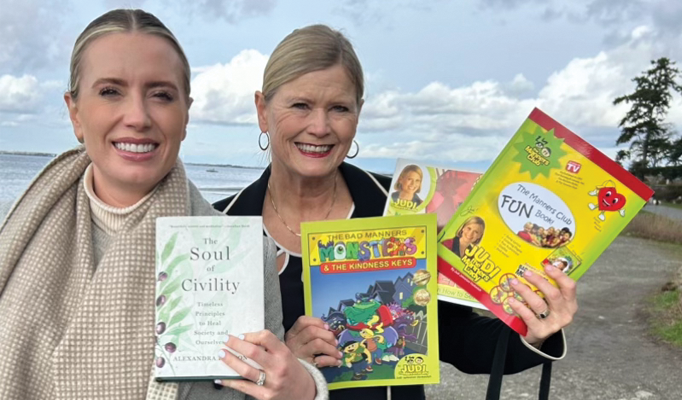
There’s good news. Alexandra Hudson and her mom Judi Vankevich have launched a civility revolution, to bring back civility and kindness to our public and private lives.  We recently attended The Soul of Civility book launch for Western Canada where Alexandra and Judi cast their vision for how goodness and decency can be brought back into the very fabric of how we do life together. 

Alexandra came home to BC from her new home in Indiana. This was part of her 35-city book tour – from Canadian Parliament to speaking at the Alabama Supreme Court – promoting the conversation around the need for civility.  Lexi, as she is known by her friends, attended TWU, followed by her Masters’ Degree at London School of Economics on a Rotary scholarship.

Judi is internationally known as Judi The Manners Lady. She is an award-winning singer, family entertainer, educator, and author.  Her book and videos help the often forgotten Ten Commandments come alive for children.  Her CD, “It’s Fun to Have Good Manners!” won Best Children’s Album of the Year for the Covenant Awards. Judi’s new children’s book, The Bad Manners Monsters and The Kindness Keys, is an allegory to help children (of all ages) “take every thought captive.”

Judi first launched the non-profit Civility Project in 2003.  Langley, Abbotsford, and Vancouver were the first communities in Canada to celebrate National Manners and Character Day and now they are planning on launching the Civility Movement across Canada and the US.

Alexandra said that her parents, Judi and Ned, a TWU Professor, are wonderfully intellectually curious.  They gave to Alexandra their love for the great Russian Christian philosophers like Tolstoy, Dostoevsky, and Solzhenitsyn.  Her upcoming book is on autodidactic learning, which is self-taught and ongoing. She wants Christians to more intentionally reclaim their robust intellectual and historical heritage.

A city councilor from Carmel, Indiana invited Alexandra to launch their community-wide, multi-event civility conversation with the theme, “We Can Do Better.”  Alexandra shared how we can recover civil community through learning to ‘porch’ together. By this, she means not just relying on impersonal social media, but actually hanging out together in person on each other’s porch, front lawns, coffee shops, or similar shared spaces.  The civility revolution can start in very small ways.  Our internet algorithms encourage us to hide from others in our self-absorbed silos, never deeply listening to those who might think differently than us.  Our highly divided culture often encourages us to fear those who hold different view on specific issues.  Alexandra encourages us to rediscover the humanity of every person who are all made in God’s image. So, all people are of deep inherent worth and dignity.  Civility is not yelling at the other person to make your point, but stopping to think and then conversing quietly and gently with them.

As a dual citizen, Alexandra has been active in politics in both Ottawa and Washington, DC. Sometimes she met aggressive, impolite people in the public realm.  What concerned her more though was outwardly polite people who were just as ruthless, first using and then discarding others.  This is why she prefers the concept of civility, because it speaks of genuine character.  Civility is not about pretending to just fit in, but rather graciously listening and then speaking your truth in difficult situations.  She observed that as family, faith, and friendships have fragmented, politics is inappropriately filling the vacuum. The political culture wars are endless.  People never get a break from politics, which Alexandra says, ends up harming our souls and family life.  Politics, which is a good thing, has become for many an idol, the ultimate source of meaning and purpose. What if we spent more time with our family, friends and colleagues celebrating the sublime beauty of God’s creation?  Wouldn’t that be revolutionary in our deeply conflicted culture?

We thank God for this mother-daughter Christian team who have not given up on kindness and civility. Rev. Dr. Ed & Janice Hird


Wednesday, May 01, 2024

FORGIVENESS - by Eleanor Shepherd

I have been reading again Philip Yancey’s classic, What’s so Amazing about Grace? My own thoughts about forgiveness have been challenged again through my rereading of the book. His chapter on forgiveness caused me to do some serious reflection, particularly concerning the state of our world today.

          I wonder if the current confused and tense atmosphere that seems to colour so many domains of life, is the consequence of a key event that has destabilized so many people, particularly in North America and the Middle East. I am thinking about what is now referred to as Nine Eleven. It happened on September 11, 2001, the day that the Twin Towers in New York and the Pentagon were hit by aircraft that caused the tragic deaths of many people and evoked an aggressive response of vengeance from the American government.

          When faced with this kind of injustice, it is normal to want to fight back and see that justice is done, but I wonder if in the long term a different response might have been more effective, and the world might be less fractured and fragile today and could have been better equipped to deal with a global pandemic.

When immediately following Nine Eleven, I heard the frantic calls for arming to combat the Enemy who was responsible for this tragedy, I had a strange feeling in the pit of my stomach that this was not the best way to move forward. Yet, I heard nobody objecting to the hue and cry for vengeance, so I thought that I must be the one who was totally out of step with reality. Maybe that is the case. Nevertheless, I feel that I must express what I think would have a much more reasonable way to handle the situation and might have in the final analysis produced some positive results.


          Just image with me for a moment what would have happened if the President of the United States had made some comments like this:  “Today, we acknowledge the terrible things that have been done and the needless suffering and sorrow that has resulted from these horrible actions. We grieve and lament with those who are the victims of such violence. Nevertheless, we consider ourselves a Christian nation and for that reason, how we respond is not with a flexing our military power and bringing out our strongest weapons to retaliate and see that justice is done.”

“We follow One who was willing to Himself bear all injustice and evil, all that we call sin, so that we could enter into a relationship with our loving Heavenly Father, whose greatest desire is for all of us to know His love and forgiveness. Because we receive forgiven for the wrongs that we have done, we are choosing to forgive you for the wrongs that you have done to us. Our desire is for you to discover the Way of Love, the Way that we have chosen to follow as we follow Jesus Christ. That is what it means for us to be Christian.”

          “We believe that it is not our place to see that vengeance is meted out to those who have done wrong. Our God tells us that He will see that justice is done and that if vengeance is needed, He will see that it takes place according to His perfect plans.”


Such speaking would reflect an attitude of trust in God, not a trust in our own wisdom and power. That is why a cross and not a sword is the symbol of our faith.

          While this example is perhaps the most obvious, in whatever country we live today, we are seeing a turning to violence and hatred to deal with whatever we feel is unjust. To my mind these attitudes are an affront to and a denial of our Christian faith. I suspect that Jesus weeps with us as He sees the way that we treat one another. Echoing in our hearts and minds come His concluding words to His followers, according to John, who knew Him well. “The world will know that you are Mine by the love to show to one another.” Love is willing to pay the price of forgiveness.


Popular Posts