Wednesday, June 05, 2013

Transitions - Eleanor Shepherd

"Life is all about transitions."  If I was writing this about ten years ago I would likely have said that life is all about change.  However it seems that the idea of change has become so prevalent that it has taken on negative connotations. We can lose ourselves in change.  So now the operative word is transitions. It seems a little gentler.  When we transition to something it sounds like we are in a process of gradually letting go of what we had as we reach for what lies ahead.  In my mind, I hear a piano sonata that modulates gently from one theme to another, carrying us along with it.

It is true that life is all about transitions.  I have watched that over the last twenty months as I have interacted with my little granddaughter.  When she arrived she did little but eat, sleep and display normal bodily functions.  However our joy was in watching her awaken from sleep and discovering her expressions as slowly she began to respond to the world around her, beginning to transition from a neonate to an infant.  Before many weeks, she began to interact with the familiar faces and her first smiles appeared.


As her little body grew and developed, she began to transition into mobility.  Instead of remaining on her back in the crib, she learned to roll over and before long she was sitting up on her own and next thing we knew she was skittering across the floor having developed her own method of locomotion.  Transitions came fast and furiously as she began pulling herself into an upright position, learning to bear her weight on a her legs and feet and the next thing we knew she was walking and running.  No longer an infant, she had transitioned into a toddler.


Equally astounding to this rapid transition from complete physical dependence for mobility to independent locomotion has been the transition from muteness other than cries to indicate discomfort or distress to a mimicking of words in three different languages.  It began with the chuckles and chortles of delight at discovering she had a voice and could use it.  The transition to comprehension of what was being said to her seemed almost imperceptible until she began responding to the instructions given to her and it was clear that she was understanding the meaning of words.  To think that all of these transitions have happened in only twenty months is astounding.  Were the changes to continue to occur as frequently over the next twenty years, the future would be unimaginable.  Fortunately the pace slows. We become conscious that we can choose the role that we will play in transitions.  Sometimes the results are not what we anticipate.  Perhaps that is why as we age we are not as quick to embrace the changes.  Our ability to relish them declines when they do not always lead to life and growth.

What is the turning point? When do we move from anticipating change with joyful expectation to accepting transitions as inevitable.  What are the triggers that engender a change of perspective? Is it when we finish our formal schooling and discover that we need to enter into a world where we must transition from a form of dependence to autonomy, taking responsibility for our own future? Is it when we decide to enter into a significant relationship as we weave our lives together in the stability of support from a reliable life partner.  Is it when we finally find our career niche, doing something that brings us satisfaction in our daily labour?  Perhaps it comes with the growing awareness    that our active years in the labour market are quickly coming to a close or when we discover that our body is no longer reliable and presents us with unexpected health challenges.  Do these events cause us to feel more cautious about our transitions, knowing the eventually our places will be assumed by others and what then?

Transitions will at many points intersect with the life of faith. We can view change and transition as part of a megastory. Through all of the transitions of life, when we are people of faith, there is always an eternal element present.  All that we do and all that we are have repercussions beyond our present existence.  We know that our final transition will be into a glorious existence beyond what we can currently imagine.  In preparation for this, we can embrace the changes, though we may not always welcome them.  We will have the courage to move through the transitions buoyed by the knowledge that our lives are in the hands of One who enfolds us in His grace, through all the changes. He has promised never to leave us or forsake us.  


Word Guild Award 
2011


GOOD NEWS--Alan Reynolds


GOOD NEWS!

“For you have been saved by grace!” Ephesians 2:8

 The “Good News” of the grace of God in Jesus Christ our Lord. That’s the meaning of the word ‘Gospel.’ It is the good news that God is gracious, that God is good and God can be trusted, trusted to do what is good and right for each one of us, for those we love, and for the ultimate destiny of all creation, the Kingdom of God. That, most of all.

 The Gospel is not law, not a system of morality. It is not doctrine, a system of belief. It is Good News!
What we hear sometimes from pulpits, and from radio preachers and TV evangelists, doesn't sound like
good news.  It speaks of conditions on the grace of Jesus Christ that seem more like bad news and seem more apt to inspire fear in our hearts rather than faith.

 The "Gospel" is the good news of God's grace in Jesus Christ the Lord!  It is the Good News that "God was in Christ reconciling the world."  To reduce it to its simplest expression, I would put it this way: the Gospel, the "Good News," is that "God is gracious."  Translated as best I can into the language of today, it says "God is good, and God is just."  The Creator of all, the Power behind the wind and the wave, is good, and will be just ultimately in all dealings with humanity.

 That may seem a simple statement, but I think it has great implications.  If God is good and God is
just, then God will do what is good and right for each one of us.  And we can ask no more.  It means that I can trust myself and those I love to God's gracious care and keeping.

 So the primary Biblical meaning of what we call "faith" is not so much what we believe but in whom we
believe.  Because God is good and God is just, we can trust God.  We can trust ourselves, our very souls, into God's care.  This is "salvation" -- to live in this confidence, that the ultimate nature of nature is benevolent, in spite of the sometimes seeming angry face of the natural world.  And this is peace, the peace that passes all understanding.  For "You shall keep in perfect peace those whose mind is fixed on You, because they trust in You."  (Isaiah 26:3)

 This does not mean that "salvation" is an automatic process, that everyone is "saved" no matter what they believe or what they do.  The judgment of God is very real.  But God's judgment is merciful, its purpose is redemptive, intended not to punish or destroy but to save.

 I don't claim to know a great deal about "the furniture of heaven and the temperature of hell," but I do know that I trust in the goodness and justice of God.  Other things then seem to fall into their natural place.

 The grace of Jesus Christ is the foundation of faith.

It is the grace of Jesus Christ which makes faith possible.  Knowing the grace of God in Jesus our Lord means that we can trust ourselves to God, knowing in the light of the cross, that God can work good out of evil and life out of death, even in our lives.

 It is no longer a matter of "getting our souls saved," or finding a private escape route from judgment.  Rather it is to know and trust the Judge, to know that God's judgment is for our good, and "there's a wideness in Gods mercy."  God is good, and God is just.  Therefore God will do what is good and right for each one of us.  What more can we ask? And [for] those we love.  There need be no more the haunting, terrible fear in the heart of the widow or mother whose husband or son has died supposedly "unsaved."  We trust those we love into "the grace of Jesus Christ" as well.  They are in God's hands, and once again, God will do only what is right and good for them.

And we can ask no more.

 The grace of Jesus Christ is the foundation of our freedom

And to trust in the grace of Jesus Christ is the basis of our freedom. It frees us from guilt and subservience to any human power.  For instance, we come to church not because we have to, in order to "get in OK," but as a privilege and pleasure, because we want to and know we need to.  If we earnestly seek to live through the week in the Spirit of Jesus, we will seek the worship service by Sunday morning and no doubt we will fervently join in the Confession of Sin, not because God demands our confession, but because we need to confess our sin.

The whole of life, the whole of our living, can become a Eucharist, a sacrament of praise and thanksgiving, for the goodness and mercy of God which we know in the grace of Jesus Christ.

 The grace of Jesus Christ is the basis of morality

 So then, "doing what's right" is not an enforced code of ethics. ( ie; "God will punish you if you do that.")  Sin is not just "an offence against God."  Sin offends God because it harms the humanity which God has created "in the image of God" and the creation which is God's handiwork.  What is "bad" is bad because it's bad, bad for us, bad for others, and bad for God’s creation.  Bad for the oceans and the air, and bad for the very earth itself. And we are "good," not to avoid punishment or claim reward, but simply "good for nothing," because what is good is what is good for us and for all.

 Accept that you are accepted!

It appears to be so simple, yet so many people find it so difficult. Accept that you are accepted.
It is as if a voice were saying; “You are accepted. You are accepted, accepted by that which is greater than you. 

Everything is transformed. In that moment, grace conquers sin and reconciliation bridges the gulf of estrangement.

And nothing is demanded, no religious or moral or intellectual presupposition, nothing but acceptance
(Paul Tillich, “You are accepted,” in The Shaking of the Foundations, p. 162.)                      


Tuesday, June 04, 2013

Change - Necessary Word/MANN

Change is inevitable! Isn’t that what life teaches us? People say, “Better get used to it; it isn’t going to go away.” I suppose the only thing that doesn’t change is change itself. Somehow, that doesn’t help. In terms of our faith, we state that God’s love is unchangeable. This one truth remains consistent. In a world of changing economics, attitudes, moral, ethics and aging, it’s a relief to acknowledge that God’s love remains firm, true and faithful.
Faithful – that’s an interesting word. We use it often and sometimes without much thought. Yet, to be truly faithful is to remains dedicated and timeless in our response. 
Recently I pulled a manuscript up on my monitor that I hadn’t worked on for a while. As I read, I realized I would have to revise it a lot because of new perspectives I had on the topic. I asked a small-membership church consultant to review it for it’s relevancy to today’s church. He immediately requested that I clearly define the meaning of the word, faithful. “What do you mean? That word means different things to different people in the small church.” Good point, but somehow I didn’t want to hear it. I guess I like to think everybody uses the same dictionary.
However, I admit to people using words and phrases in conversation when I wonder about the logical meaning and I might say the same thing as the consultant, “Can you unpack that  word for me.” Or “What does that mean to you?” And when I do, some look at me and stumble with another phrase or word that invites me to say, “Can you say a little bit more about that?”  
Cracking open the word faithful caused me to query, ‘faithful to what, to whom? and why?’ To respond is of utmost importance to know to whom, to what, and why we are committed and then decide how to honour our loyalty. This leaves me to think, I cannot make a faithful decision with only self in mind. I have to identify who else is at the table—another unchangeable principle in life. 
However, having said that, I admit one’s own perspective and culture determines the definition of this word in relationships, agreements, legal arrangements and vocabulary.

The latter caught my attention when a friend of mine recently passed back to me a letter I’d written to her in the 80’s. As I read it, I thought, “Yes, these are my experiences, but it’s not my vocabulary and not my expression of faith.” It caused me to pause, acknowledge and appreciate the expressed experiences in a new way, knowing I would use different religious language to interpret them now—perhaps another unchangeable principle.
So, Faithful Choices: A discussion book for small-membership churches is back in the land of the living, facing a big revision. Now I just have to get my mind around the necessary changes and acknowledge that they are for the best. That too is an inevitable change and yes, maybe another unchangeable principle.
Blessings,
Donna
Watch for Faithful Choices: A discussion book for small-membership churches     

Monday, June 03, 2013

Beautiful Words and Beautiful Writing--Carolyn R. Wilker


Photo credit: Clickr Photography
When was the last time you put down a book to ponder the words and then reread a section of text that put a thought so beautifully that you wished you had written it? Writing that uses classy language with metaphor and depth while telling a good story.
An author who quickly comes to mind, for me, is Lucy Maud Montgomery, writer of the Anne of Green Gables series and other stories and poetry. She was a master of language, and not by accident.
 In the opening to the first Green Gables book, there’s an image of a little brook that flows through Avonlea: “it was reputed to be an intricate, headlong brook in its earlier course through the woods, with dark secrets of pool and cascade, but by the time it reached Lynde’s Hollow it was a well-conducted little stream, for not even a brook could run past Mrs. Rachel Lynde’s door without due regard for decency and decorum.”
I’ve reread the first of the Green Gables books at least three times, because I appreciate her writing and the opening to her series. Montgomery had a gift, but she also worked at it, day after day, week after week, making time for writing between all the other details of her life—as a young girl, through school and university, as a young woman taking care of her ailing grandmother, then later as the wife of a minister and mother of young children. She made a way to write, and she wrote prolifically.
Lest we idolize her, which might be easy to do since her work gained so much popularity, she also had challenges in her life, but she used writing to advantage, perhaps even as an escape. She herself, an orphan, wrote about an orphan who had an incredible imagination, was a dreamer, and who really just needed someone to love her.
I’d call it more of a fascination with this writer, within a life that was anything but easy.
Irene Gammel, author of Looking for Anne, says that in writing about the character, Montgomery writes a great deal about herself. One might have called it “looking for Maud” in the Anne character, but Gammel turns it around, since in fact the subtitle is How Lucy Maud Montgomery Dreamed Up a Literary Classic.
In conversation with Elizabeth Waterston at an event in Guelph in 2008, I learned that she, too, first read Montgomery’s work as an adult. Waterston, co-editor of Montgomery’s diaries with Mary Henley Rubio, first learned about Montgomery during her graduate studies.
My first encounter with Lucy Maud’s writing came as an adult hearing other people talking about her books, going to the library to find them, and falling in love with the character Anne and the author’s writing style. Waterston and I share the fascination, yet she has the greater insight from her studies of Montgomery and the body of literature the author created that others can learn from.
Rubio writes on the inner cover panel of her book Lucy Maud Montgomery: The Gift of Wings: “The writings of Lucy Maud Montgomery are so familiar, so captivating that it is easy to feel we know her. But the complex woman behind the classic story Anne of Green Gables experienced the dark side of life as well as the intense joy of creativity.”
In all the books and authors I’ve read as an adult, I have encountered many authors who have worked years to develop their craft and contribute to a body of writing, and who keep writing day after day because to write is so important to them.
To those who write beautiful words and powerful stories, and in celebration of excellence in writing, I say thank you, and thus, today I pay tribute to my top favourite author, L. M. Montgomery.

                         placard photo at Green Gables, PEI, photo by C. Wilker

    from the 100th anniversary of the publishing of Anne of Green Gables, photo by C. Wilker

                                             In 2010 at Green Gables, photo by C. Wilker


Carolyn Wilker
www.carolynwilker.ca


Friday, May 31, 2013

William Carey: Educational Pioneer - HIRD


By the Rev.  Dr. Ed Hird


William Carey1

Who was William Carey, and why has he had such a major impact on our global culture?  On May 26th , I graduated with my Doctorate from Carey Theological College on the UBC Campus.  While at Carey College, I often walked past a painting of Carey, showing his humble beginning as a village shoemaker in Paulersbury, England.  Carey was fascinated with reading books about science, history and travel journals of explorers like Captain Cook.  His village playmates nicknamed him Christopher Columbus.  Carey said that he was addicted as a young person to swearing, lying, and alcohol.  A major turning point happened when he was caught by his employer embezzling a shilling.  Fortunately his employer did not press charges.  For such petty larceny, Carey could have easily paid the price of imprisonment, forfeiture of goods and chattel, whipping or transportation for seven years to the plantations of the West Indies or America.  Facing his own selfishness, Carey had a spiritual breakthrough by personally meeting Christ that had a lasting impact on his values and lifestyle.


Carey had a quick mind and a natural love of learning. He would have normally become a farm labourer, but suffered from a skin disease that made it painful for him to go out in the full sun. If Carey’s face and hands were exposed to the sun for any lengthy period, he would suffer agony throughout the night.  So instead he became a cobbler, making shoes.  While making shoes, he was able to read and pray.  Through this, Carey developed a conviction that he was to go to India.  His unimaginative friends and colleagues tried to talk him out of this fantasy.  His five-month pregnant wife Dorothy was also dead-set against it.  His own father Edmund wondered if his son had lost his mind.  Carey said to his dad: “I am not my own nor would I choose for myself. Let God employ me where he thinks fit.”


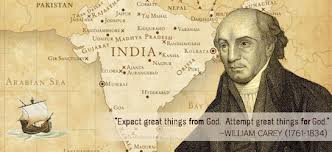
William CareymapWith unshakable determination, Carey went to India in 1793 which was under the control of the East India Company.  He later ended up becoming a Professor of Bengali and Sanskrit in Calcutta, India.  Through teaching at Fort Williams College in Calcutta, he was investing in young civil servants from England, helping them to have a good start in India.  Carey believed that the future was as bright as the promises of God.  He had an exceptional natural gift for languages.  Carey called himself a plodder; whatever he started, he always finished.   Unlike a number of his family members and closest friends, Carey survived malaria and numerous other tropical diseases.  His first wife Dorothy however had a nervous breakdown before later dying.  Carey was heartbroken.


Some bureaucrats from the East India Company did their best to expel Carey and his team from India.  Anything that might affect financial profit was seen as a threat.  William Wilberforce however, having finally abolished the slave trade, presented 837 petitions to the British Parliament representing over half a million signatures, requesting that ‘these good and great men’ be allowed to stay in India.  Carey’s enemies attacked him in Parliament for being a lowly shoemaker.  Wilberforce won the day in the Charter Renewal Bill of 1813.

William Carey collegeCarey’s motto was “Expect great things from God; attempt great things for God.”


            Entirely self-taught, Carey impacted the emerging generation of Indian leaders that birthed the burgeoning modern democracy of India.  Serampore College was founded by Carey and his colleagues in 1818.  He produced six grammars of Bengali, Sanskrit, Marathi, Panjabi, Telugi, and Kanarese, and with John Clark Marshman, one of Bhutia.  He also translated the whole Bible into Bengali, Oriya, Marathi, Hindi, Assamese, and Sanskrit, and parts of it into twenty-nine other languages or dialects.  Scholars say that Carey significantly contributed to the renaissance of Indian Literature in the nineteenth century.


William Carey StampWhile an ordained preacher and a church planter, Carey was fascinated with all aspects of daily living.  In 1818 Carey founded two magazines and a newspaper, the Samachar Darpan, the first newspaper printed in any Asian language. He was the father of Indian printing technology, building what was then their largest printing press.  Carey was the first to make indigenous paper for the Indian publishing industry.  He brought the steam engine to India, and pioneered the idea of lending libraries in India.  Carey introduced the concept of a ‘Savings Bank’ to India, in order to fight the all-pervasive social evil of usury at interest rates of 36% to 72%.


Carey introduced the study of astronomy as a science, teaching that the stars and planets are God’s creation set by him in an observable order, rather than astrological deities fatalistically controlling one’s life.  He was the founder of the Agri-Horticultural Society in the 1820s, thirty years before the Royal Agricultural Society was established in England.  Carey was the first person in India to write about forest conservation. In 1823, he was elected as a Fellow of the Linnean Society of London, one of the world’s most distinguished botanical societies even today.  As Carey’s favorite flowers were lilies, he had the honour of having one (Careyanum) named after him.


william-carey graveHaving a strong social conscience, Carey was the first man to oppose the Sati widow-burning and female infanticide.  Sati was finally banned by the Government of India in 1829.  He also campaigned for humane treatment of lepers who were being burned or buried alive because of their bad karma.  The view at the point was that leprosy was a deserved punishment in the fifth cycle of reincarnation.


            Carey loved India and never returned home to England, dying in 1834 at the age of 73.  Near the end, he said: ““You have been speaking about William Carey. When I am gone, say nothing about William Carey-speak only about William Carey’s Saviour.”  My prayer for those reading this article is that we too would have the passion for learning and making a difference that William Carey once had.


Video: William Carey – A Candle in the Dark (click to view)


Ed processing

The Rev.  Dr. Ed Hird,

BSW, MDiv, DMin

Rector, St. Simon’s Church North Vancouver

Anglican Mission in the Americas (Canada)

http://stsimonschurch.ca

-an article for the June 2013 Deep Cove Crier

-award-winning author of the book ‘Battle for the Soul of Canada’

http://www.battleforthesoulofcanada.blogspot.com

p.s. In order to obtain a copy of the book ‘Battle for the Soul of Canada’, please send a $18.50 cheque to ‘Ed Hird’, #1008-555 West 28th Street, North Vancouver, BC V7N 2J7. For mailing the book to the USA, please send $20.00 USD. This can also be done by PAYPAL using the e-mail ed_hird@telus.net . Be sure to list your mailing address. The Battle for the Soul of Canada e-book can be obtained for $9.99 CDN/USD.

-Click to download a complimentary PDF copy of the Battle for the Soul study guide : Seeking God’s Solution for a Spirit-Filled Canada

You can also download the complimentary Leader’s Guide PDF: Battle for the Soul Leaders Guide

Thursday, May 30, 2013

Worth knowing: Will anti-creationism hysteria targets homeschoolers? - Denyse O'Leary

In an age when it is hard to get an education no matter what you pay, expect to see public uproars about supposed evildoers. Creationists are a classic because no one cares whether kids learn anything or end up in jail or on welfare, as long as they are not taught “creationism.”

 Also Is twenty-five really the new fifteen? Or is that a better headline than a concept? The authors of the Escaping the Endless Adolescence argue:

Wednesday, May 29, 2013

Hope Floats by Glynis M. Belec


This past Sunday I shared a message during a worship service.  I have spoken many times to all kinds of wonderful audiences - young and not so young. I've led many workshops in schools, at conferences, and in church fellowship halls. As a church drama leader and actor from way back, the upfront stuff isn't foreign to my blood. But this was my first time ever being responsible for the message during a worship service.

     When the lovely Pastor from the Moorefield United Church asked me a few weeks ago if I might be interested in speaking to her congregation, I wondered about my ability to be effective. My thoughts honed in on how would I do it? Could I do it? Would I say the right things? Then something hit me. I had the wrong focus. Speaking in Church was not about my abilities, fears and suppositions. If there was a message to be relayed and imprinted on some hearts, then God would look after that. Once I got that thought circulating in my grey matter, the decision was easy. I said yes.
Thank you Moorefield UC for opening your arms.

And what a wonderful time it was. Moorefield United Church welcomed my hubby and me with open arms. We knew many of the people there and those who we didn't know seemed just as sweet.

The title of my message was Hope Floats. (I chose to speak on hope, at the urging of a special friend who knows my heart.) In true dramatic fashion I put on my borrowed PFD [personal flotation device] and we set sail with Jesus at the helm.

My family bought me this one Christmas.
Were they trying to tell me something? 

My butterflies soon settled as I spoke to the sea of smiling faces. The more I said, the more I felt the calming voice of Jesus. My words, that I was so concerned about, floated forth. Hopefully a tiny seed of encouragement was born. My real prayer was that someone who was hurting and wondering was able to find renewed hope in Jesus through my experience.

I told those who were listening that I am no great theologian. I explained that I was just like everyone else with a story. I just had the opportunity to be the one to share a snippet of my story that fine Sunday Morning.


I took my rock with me for another
'object' lesson!
 Before I knew it the time had flown by and I was sharing the final words. God was good. God is always good. Sometimes it is difficult to grasp especially through the dark days, but God is always in control and is always good. He was particularly good Sunday morning when we got to have lunch with some joyfully kind parishioners afterwards. Then when I got that telephone call later from the lady who wanted to personally thank me for the encouragement and renewed hope she found...yep...I understood then that God really is good and having hope in Him, alone, is the way to that perfect peace that truly does passeth all understanding.

Hope in Jesus is what really keeps us afloat!
1 THESSALONIANS 1:3 Remembering without ceasing your work of faith, and labor of love, and patience of hope in our Lord Jesus Christ, in the sight of God and our Father.

Monday, May 27, 2013

The Gift That Wasn’t—den Boer

The phone rang. It was Marnie. “Marian, I’m embarrassed to tell you this; I bought you a present.”

“For me? You did?”

“For your family.”

“What’s the occasion?”

“Oh, just because you’re nice and Marty and Allison had a birthday.”

“So why are you embarrassed?”

“Well, because the present is so nice.”

“That’s embarrassing?”

“Yes, because I’m keeping it. I bought it for you on Friday, fell in love with it over the weekend, and I can’t bear to part with it.”

“Thanks, I guess.” Marnie and I, good friends since high school, over 20 years ago, don’t often buy each other presents, so I was sort of grateful for the thought. “What in the world is it?”

“It’s a bird.”

“You bought us a bird. Oh, Marnie thank you.” Now I really was grateful. How many friends do you have who would buy you a bird and keep it for you?

You see, our four children had been bothering Marty and me for a pet and again this year we had promised to look into it. The truth is I don’t like pets. I don’t mind admiring someone else’s pets, but I don’t like to take care of a pet. If a pet came to me toilet-trained (that’s flush toilet), I might reconsider.

It isn’t that we haven’t tried to meet our children’s desire for animal friends. We took them to the zoo once and we’ve lived next to people with rabbits and dogs. We’ve even owned goldfish, but they died. Our gerbils died too. So did the puppy we had for three days: the one that slept under the car.

“I knew you were looking for a pet and as soon as I saw her I thought of you,” continued Marnie. “She’s got a big cage and she talks.”

“She talks?”

“It’s a parrot.”

“A parrot? You bought us a parrot? Expensive, I bet.”

“Yeah, but that’s okay. You’re worth it.”

That evening I told Marty and the kids, “Aunt Marnie bought us a pet.”

“She did? What is it?” the kids chorused.

“It’s a bird, a parrot, but we’re not getting it because she fell in love with it.”

“Aww.” The disappointment was showing.

“But,” I added, “we can go look at it and maybe think about getting one like it.” Notice how I didn’t commit myself.

Several evenings later we were introduced to Zack. (She was named before they figured out her sex.) She was a pretty green bird with a yellow patch on her head, orange eyes and several red and blue tail feathers.

“Hello,” she said. “Tickle, tickle. Want a peanut? Thank you. Bye.” She whistled, she barked and she meowed. The kids loved her.

“There’s probably not another bird like her,” Marnie said. “Nobody is allowed to say bad words in front of her: she learns words so fast.”

I actually liked the bird. I liked her all the more because Marnie wasn’t about to part with her, although she did promise we could baby-sit Zack sometime, maybe even for a few weeks when she moulted, because all those feathers would make Marnie’s family sneeze.

Our children came home raving about Zack. Angela took to reading the want ads every evening. She only came across one parrot, but by the time we phoned it was gone.

Maybe I could talk the kids into settling for a bird-feeding station in the backyard.

“Which of you, if his son asks for bread, will give him a stone?” (Matthew 7:9)

My sentiment toward pets mirrored my attitude toward the Holy Spirit. It was okay for my sister-in-law to speak in tongues, but I was not interested in receiving that “gift” as she called it. Prophetic words, miracles, signs and wonders were all evidences of the Holy Spirit which I enjoyed reading about in the Bible, but I was not expecting to experience those things personally. Little did I know that in the not too distant future, even as Zack would come to live at our house, the Holy Spirit would captivate me.

Excerpt from Blooming, This Pilgrim's Progress by Marian den Boer. I'm currently working on a novel, Minnie Goes to Heaven. Visit my blog to catch the work in progress.

Friday, May 24, 2013

Dead or alive—animals teach us - Gibson


As I greeted our daughter Amanda at the front door the other day, she pointed to something on the deck—a narrow strip of thickly-furred deer hide, a foot long, recently detached from its owner.

She sighed. “Mom, are you bringing dead animals home again?”

The family has never allowed me to forget that decades ago, I once picked up road kill. Arriving home, I called, “Guess what I've got in the trunk?” Family came running. No one answered.

“A dead body,” I whispered. The Preacher almost swooned—likely more from the stench than the shock. But I used the quills I harvested from that dead porcupine for years.

They also insist on bringing up the half-dead squirrel I dragged home from a picnic. (The children insisted, but that part seems long forgotten.) We cleared the food from the cooler and put the squirrel in, hoping to doctor it at home, or at least let it die in peace. Somehow it got loose in the car. I'd rather not talk about the lesson I learned that day—but the policeman who pulled me over may still be.

“I wanted to show it to the beans,” I said, of the strip. Amanda rolled her eyes, likely remembering the brown bat in Neighbour Ed's yard. I thought it would make a good nature lesson, with its carefully designed wings and soft fur—and I didn’t stop her when she picked it up. It seemed cute—until it bit her palm.

In retrospect, the bat taught us mostly about the science of medicine. Five of us, including the neighbour and his son, needed a month-long course of rabies vaccinations. (The Preacher didn't touch the creature—he mentions that often.)

“This time it's only a wee bit of the animal,” I said of the fur. She seemed not overly relieved. Still not sure if she wanted her children exposed to her mother's penchant for critters--dead or alive.

A few hours earlier I and a pair of friends, out cross-country skiing, had found that piece of deer draped over a sturdy, though short, tree branch, about eight feet up. Using my ski pole, I dragged it down for inspection, wondering how it got there. It reminded me of the pair of antlers the Preacher had spotted hanging about thirty feet up in another tree. That mystery on Yorkton's Hjertas Nature Trail puzzled us each time our family hiked there.

“That likely happened during the night,” my friend said. “The deer was probably trying to escape a predator.” The visual images of those frenzied minutes made me shudder—but clearly the animal had escaped.

I’ve kept the hide. It reminds me how crucial it is to flee from the enemy of our souls—even at the risk of leaving a strip of skin behind—whatever form that skin takes.

Got an attractive temptation, an unhealthy relationship or habit? Considering an unethical deal? Take a lesson from the deer—leave it behind. A strip of skin is a small price to pay for your spiritual survival.

Even Amanda agrees—that’s a lesson worth bringing home.


Kathleen Gibson ponders faith and life in her newspaper column, Sunny Side Up, and her 90 second radio spot, Simple Words, aired on local and not-so-local Christian radio.

Watch for Kathleen's upcoming contributions to Scripture Union's new Bible App, "theStory" (Genesis 18 - 24). Visit theStory here. 

The above column was published earlier this May.


Wednesday, May 22, 2013

Reunion - M. Laycock


Shades of fresh new green billow across the landscape interspersed with patches of tawny stubble and dark earth waiting for rain beneath scudding clouds and blue sky. Hawks skim the ground or perch on fence posts, eyes ever searching for prey. Here and there cattle graze, wandering down centuries old pathways grooved into the side of low hills. It's springtime in Alberta. The long wait for winter to end has passed but now a new anticipation hovers in the soft air. Will the rains come? Will the crops sprout and yield their harvest? The potential for either feast or famine is there, walking the tightrope of weather forecasts and mechanical failures. 

I feel the tight coil of waiting inside me. Thoughts of "what if" press it down hard until the whisper, "I am with you," breaks through and the tension eases again. Then the distraction of time spent with old friends brings laughter and tears. The sweet sweet song of two young girls, smiling as they sing about Jesus catches in my throat and eye contact with a friend brings a knowing smile. Walking the dirt roads of a country town on a tranquil evening, the joy of discovering new places together makes us giddy and the unexpected certainty that God is walking with us tingles my spine.

All too soon it's time to pack up with hugs all round to say good-bye as we step out into a cooling shower. Blessings falling on us all, on the land. The seeds will yield their fruit. Though weather may turn and machines may fail, the harvest will come. He is with us.
****

Marcia Lee Laycock writes from central Alberta Canada where she is a pastor's wife and mother of three adult daughters. She was the winner of The Best New Canadian Christian Author Award for her novel, One Smooth Stone and also has two devotional books in print. Her work has been endorsed by Sigmund Brouwer, Janette Oke, Phil Callaway and Mark Buchanan. Marcia's second novel, A Tumbled Stone has just been short listed in the contemporary fiction category of The Word Awards. Abundant Rain, an ebook devotional for writers can be downloaded here. Visit Marcia's website

Monday, May 20, 2013

What is a Christian Writer?

I have a book that I bought many years ago when I first began my writing journey. It is Ethel Herr's book An Introduction to Christian Writing. It's a great book and one I encourage new writers to pick up.
I'd like to share with you a few of the points she brought out in her first chapter about writers who are Christian and what their responsibilities are:

  • A Christian Writer is - someone who writes! Sounds rather obvious doesn't it? They are editors, magazine staff writers, public relations specialists, technical writers, writing teachers, novelists. They are writers who happen to be Christian. In other words they have a personal relationship with Jesus Christ. They belong to a body of fellow-believers. Jesus Christ is our Head and gives us our typing orders. 
  • A Christian Writer is - a believer at worship. Ethel Herr says, "We tend to think that we are first ministers with a pen. However, before we can minister, we must learn to worship and regard all our writing as an act of worship offered to the God of the universe. Everything we do and say must be an act of worship, done for God's pleasure." I like that  reminder! If we approach our writing as an act of worship done for God's pleasure, we will never write something that would violate, trivialize or compromise our basic beliefs.
  • A Christian Writer is a ministering prophet with a broken heart. Biblical prophets who preached judgment never delivered many words of fire without stopping to weep and plead with God's people. No matter how urgent the message, we must first let God break our hearts with the thing that makes Him weep, then weep with Him as we write. God has called us to be servants of Jesus Christ and to serve one another. We will write to meet others needs rather than our own. We will present all of life from the Christian viewpoint. The author also shares a warning her pastor gave her in regards to success as a writer - "There is always the danger that what begins as a humble service to God will become a desire to be great." 
  • A Christian Writer is an artist. Art is more than painting a picture. Art is music, acting, dancing, poetry - in other words, art is a reflection of self-expression, a gift of God that we share from our hearts to bring encouragement, beauty and pleasure to our readers and to God.
  • A Christian Writer is a craftsman. The craft of writing is an exercise in the disciplines of polishing and perfecting our work. Craftsmanship is workmanship - the 95 percent perspiration that must accompany the 5 percent inspiration before a piece of art can take shape. Ethel Herr goes on to say that:
  1. A craftsman takes pride in his work. He cares more about the quality than the sale-ability.
  2. The craftsman works with untiring diligence. 
  3. The craftsman nurtures growth in his person and in his writing. 
  4. The craftsman can take criticism and use it constructively in developing his craft.
The author sums up what a Christian writer is with these four principles:
  1. Weep. Look around you; see your world. Look within; know yourself. Look up to God; learn His expectations. Then let Him break your heart.
  2. Pray. Take time to pray each project into being. Don't rush into publication.
  3. Think. Think your subject through. Research it thoroughly. Produce mature, intellectually sound and honest work.
  4. Work. Be prepared to do plenty of this, but not without the first three steps.
Now, let the discussion begin. What do you think a Christian writer is? Someone who just happens to be Christian and a writer? Or, as the author suggests, a minister to those they are writing for? I'd love to hear your comments. If you are on Facebook, please leave your comments on my blog site so that others can follow along. Thanks!

You can purchase Ethel's book here


Until Next Time!


www.laurajdavis.com
www.learningfromthemaster.com
www.interviewsandreviews.com

Popular Posts