Showing posts with label India. Show all posts

Thursday, July 09, 2020

Dr E Stanley Jones, the Billy Graham of India -HIRD


by Rev Dr. Ed & Janice Hird,
What if we told you that in his lifetime, Dr. E. Stanley Jones was the most-widely read spiritual author in the entire world, with 28 books, some selling millions of copies?   Born in Clarksville, Maryland, in 1884, Time Magazine called him the world’s greatest missionary.   In 1964, Time stated that Jones’ “fame overseas as an evangelist is matched only by Billy Graham.”  Many see him as the Billy Graham of India.   Billy Graham spent ten minutes in his 1963 Los Angeles Crusade, commending Jones's missionary work, calling him his “good friend and trusted advisor.”  Billy Graham wrote in his final book that Jones “made a profound impact on all those around him because of his extraordinary faith and service to others…His is a worthy testimony of living a meaningful life during the journey to eternal life.”
Jones initiated “round table conferences” at which Christian and non-Christian sat down as equals to share how their spiritual experiences enabled them to live better.  Tom Albin said that “everyone was asked to share only their religious experience and specifically ‘how religion was working, what it was doing for us, and how we could find deeper reality.’”    Serving in India for over 50 years, Jones was personal friends with Mahatma Gandhi.   A top spokesman for the Indian government, when Jones received the Gandhi Peace Prize, called him “the greatest interpreter of Indian affairs in our time.”  Who could have imagined that God would use Jones’ book on Gandhi to inspire Martin Luther King Jr to launch the non-violent civil rights movement?  King told Jones: “It was your book on Gandhi that gave me my first inkling of nonviolent noncooperation.”
While in England, Gandhi for the first time read the Bible, finding the New Testament compelling, especially the Sermon on the Mount.  As Gandhi commented, it ‘went straight to my heart’.  Because Gandhi daily read the Sermon on the Mount, Jones said to Gandhi “You know the principles.  Do you know the person yet?” Gandhi confessed that he didn’t but was searching.
Early in his missionary service in India, Jones suffered a physical and emotional collapse.  Telling the Lord that he was done, he surrendered his ministry to Jesus, and the Lord miraculously restored him.   Self-surrender became his theme and song. 
There are many United Christian Ashram retreats across Canada and around the world.  Many members of our family have been powerfully impacted by the past 47 years of the BC Christian Ashram. The first one was started in India by Dr. E. Stanley Jones in 1930, after spending time at Rabindranath Tagore’s and Mahatma Gandhi’s ashrams.   Jones said that only Jesus was good enough to be the leader, the guru of a Christian Ashram.   He was very Christ-centered, teaching that the highest thing we can say about God the Father is that he is Christ-like.  Inscriptions on the original Christian Ashram walls in Sat Tal, India, said, “Here everybody loves everybody”, “East and West are alternate beats of the same heart”, and “Leave behind all race and class distinctions, all ye that enter here.” Jones commented that in the Christian Ashram, barriers of class and cash disappear completely.  A black man shared, “This has been the first week of my life in an unsegregated world. I have lost my resentment against white people.” 
Jones was exiled by the British government during World War II because of his stand for racial equality and independence for India. Experiencing reverse-culture shock, Jones spoke out against American racism on NBC radio:
“When I landed on the shores of my native land on September 7th, had I obeyed my impulses I should have taken the first boat back to India … I must confess I came to America with deep questionings and concern. From a distance your civilization seemed superficial and your Christianity inadequate.“ 
He told a critic: “If I should be kept back from India permanently, God forbid, then I should consider seriously giving the balance of my working days to help the (Afro-Americans) of America to an equal status in our democracy and to their fullest development as a people. For the color question has become a world question.”  This time of exile also enabled him to transplant the Christian Ashram movement to Canada and the United States.  For many years, Stanley Jones spent six months in North America conducting city-wide missions and Christian Ashrams, and the other six months overseas.
Because of his global impact, Jones the peacemaker was invited to periodically meet with Presidents Roosevelt and Eisenhower, General Douglas MacArthur, John Foster Dulles, and Japanese Emperor Hirohito.   Jones saw everything through the eyes of the Kingdom, seeing inequality and racism as violation of Kingdom principles.  He called the caste system “India’s curse”, similarly rejecting the curse of racism in his own American homeland.  In a 1947 article “India's Caste System and Ours,” Jones commented. “The caste systems of India and America are fundamentally alike – they are both founded on blood.”  For Jones, the sin of racism had set back the cause of missions and democracy, saying
“There are no local or national problems any longer. Our treatment of the (Afro-American) is a part of a world racial problem and should be treated as such … You and I know that the central problem of Missions in the East is the white man’s domination. It haunts every gathering, public and private, we have in the East.” 
He was one of the first in the States to have desegregated meetings, causing some people to gossip about Jones as a communist agitator.  Jones also served on the Advisory Committee for the Congress of Racial Equality (CORE), which organized the Freedom Rides of the early 1960’s.  Reader’s Digest published an article entitled “Methodism’s Pink Fringe” (February 1950), portraying Jones as a Communist sympathizer, or worse. Jones responded ironically “Breathes there a man with soul so dead, who never has been called a Red?”   Because of his connection with Gandhi, Edgar Hoover had a 117-page FBI file on Jones.  Since he led so many communists to Christ, the communist leaders were not very happy about him either.  Jones replied, “You say, ‘He tends dangerous towards social equality between the races.’ If this be a crime, then so be it. It is a treason against democracy and against the Christian faith to advocate inequality of treatment between the races.” If the local laws required that blacks sit in the balcony, Jones instructed groups of whites on the main floor to move to the balcony themselves when the service began.   Dr. Bob Tuttle commented “Stanley had the pulse of the world. Who was more global at the time! He was the true renaissance man.” E Stanley Jones was truly a global firestarter for Jesus’ Kingdom. 
Click on this link to learn more about the United Christian Ashrams. www.christianashram.org

Rev. Dr. Ed and Janice Hird
Co-authors of the  Blue Sky novel
-previously published in the Light Magazine


Tuesday, June 09, 2015

Lessons from Gandhi - HIRD

By The Rev. Dr. Ed Hird


My wife, being a prolific reader of novels, is always going with me to return books to the local library.  At the very front of libraries is a section for recommended new books.  While there, I was pleased to find a brand new book Gandhi Before India.  It was news to me that Gandhi was excommunicated by his own Bania caste from daring to go to England to become a lawyer.  Gandhi’s family sacrificed greatly to send him to England, even pawning the family jewels.    While in England, Gandhi for the first time read the Bible, finding the New Testament compelling, especially the Sermon on the Mount.  As Gandhi commented,  it ‘went straight to my heart’.   The lines about offering one's cloak to the man who had taken away one's coat touched him greatly.  Gandhi went on to demonstrate that the Sermon  on the Mount will radically change one’s life and one’s society if put into practice.
After completing his law degree in England, Gandhi returned to India for a short while before moving to South Africa.  While there are numerous books on Gandhi, many skip over Gandhi’s foundational twenty-one years in South Africa.  Even the excellent Gandhi movie by Richard Attenborough doesn’t do justice to the prolonged complexity to Gandhi’s time in South Africa.  Dr. E Stanley Jones commented that South Africa provided the rehearsal for the real drama of India: “He might have floundered had he tried India straight off.”  Sadly in South Africa when Gandhi was most interested in the Gospel, he encountered the greatest restrictions: “To allow Gandhi to sit along white worshippers was impossible.  The vicar's wife, out of solidarity and sympathy, offered to sit with him in the vestibule, from where they heard the service.” One of the people who had the greatest impact on Gandhi was Leo Tolstoy, especially his book The Kingdom of God is within You: “he was 'overwhelmed by the independent thinking, profound morality, and the truthfulness of this book.”  Gandhi purchased and gave out even to his jailers countless copies of Tolstoy’s ground-breaking book on peacemaking in the Sermon on the Mount.
Upon returning to India, Gandhi was initially rejected by other Indians who feared that they might become ritually polluted by even offering a cup of water to someone of the wrong caste.  When Gandhi successfully stood up for their rights, he became hailed as a hero and liberator.  Gandhi campaigned nonviolently for the independence of India for numerous decades, spending 2,089 days in Indian jails (almost six years).
Dr. E Stanley Jones described Gandhi as the architect of the new India.  In many ways, Gandhi was like an Abraham Lincoln bringing freedom to hundreds of millions of his fellow citizens.  Louis Fischer compared Gandhi to David standing up to the Goliath of racial discrimination.  Gandhi went from being an initial supporter of caste discrimination to being a campaigner against its divisiveness.
Jones held that “in Gandhi the word of freedom became flesh. When he spoke, freedom spoke. Gandhi was India.  Most people believe in democratic freedom.  Not many are willing to sacrifice over many decades to obtain such goals.  Before Gandhi, it was mostly the Indian intelligentsia campaigning for democracy.  Because Gandhi humbled himself and unselfishly served the poor and untouchables, both rich and poor awoke to the vision of an independent India.  Gandhi made room for all regardless of race, religion and wealth.  Albert Einstein said regarding Gandhi: “Generations to come will scarce believe that such a one as this ever in flesh and blood walked upon this earth.”  In reading Jones’ book Gandhi: Portrayal of a Friend, Martin Luther King Jr. was inspired to launch the nonviolent Civil Rights Movement.

Jones described the complexity of Gandhi’s personality as like Mount Everest.  In an India full of racial, religious and economic division, Gandhi brought people together, giving them a vision for an independent democratic India.  Gandhi, whose favorite hymn was ‘When I survey the Wondrous Cross’, chose the costly way of the cross, of sacrificial love even for his enemies.  On the wall of his mud hut was a black and white picture of Jesus Christ under which was written ‘He is our peace’.  Gandhi was a peace-maker who chose to forgive those who despised him and rejected him.   Every day he would read Jesus’ Sermon on the Mount, motivating Gandhi to peacefully love his adversaries.   Jones, who had been a friend of Gandhi in India for many years, said once to him: ‘You understand the principles. Do you know the person?’  Gandhi was very drawn to the person of Jesus Christ.  My prayer for the those reading this article is that we may embrace both the principles and person of Jesus’ Sermon on the Mount. 

The Rev. Dr. Ed Hird, Rector
-an article published in the June 2015 Deep Cove Crier

Thursday, April 02, 2015

What a Weasel! (by Peter A. Black)

That derogatory phrase, “What a weasel!” has sounded in my ears numerous times. I don’t recall it ever being addressed to me directly, but probably someone has either done so or wanted to. Confession time: I likely haven’t called someone a weasel, but I’m sure it’s crossed my mind.

Negative name-calling isn’t an admirable trait, but imagine a Canadian couple naming their baby daughter Weasel! Ninety years ago a Canadian couple did just that – well, sort of. They gave her the biblical name Huldah, from the Old Testament. Perhaps they didn’t check out the Hebrew root meaning and association of the name, but admired the faithful prophetess Huldah, who helped guide her people and the young king, Josiah.

Let me share a little about this Canadian Huldah (sometimes spelled Hulda). Almost forty years ago I first heard about her and her late husband, Dr. Mark Buntain, and their work in India. They sailed there with their infant daughter in 1954, with a love burning in their hearts for India’s poverty-stricken, sick and suffering people. In time they launched Calcutta Mission of Mercy, and became well-acquainted with Mother Teresa.

Their mission provided food and education, medical aid and hope to the poor. Mark died in 1989, yet with her daughter Bonnie, Huldah – now at the age of ninety – continues to head up this tremendous work, involving hundreds of workers at a variety of levels.*

The following statistics by now will have been superseded: “Together [the Buntains] established a holistic inner-city outreach consisting of more than 100 schools, over 700 churches, a daily feeding program for 25,000, and a full general hospital that has treated 2.2 million people and provided free care to 880,000.”* And there’s much more.

Huldah Buntain. Courtesy: Impact Asia:

I learned from my colleague, Rev. Tim Gibb, lead pastor of Bethel Church, Sarnia, Ontario, that the intrepid Huldah was recently a guest speaker there, and inspired the congregation with her life and message. 

A paragraph he shared from her presentation resonated in my heart. First though, I should say that the lyrics of the hymn, When I Survey the Wondrous Cross,** became a constant companion and theme, playing over again and again in my heart and mind during my Lenten journey this year – especially the last verse.

Tim tells of when Mrs. Buntain’s husband’s body was being lowered into the grave in Calcutta, in 1989, she thought . . . I have given thirty-five years in service to the Lord in this place. Perhaps my time here is done.

A choir was singing and began that final verse: Were the whole realm of nature mine, That were a present far too small . . . And as they sang the final lines, the words reached down into the depths of her spirit: Love so amazing, so divine, Demands my soul, my life, my all.

Tim remarks that she’s still going strong, helping the people in that city.

Truly a gaze-raiser!


Credit:english4U2.info
In our culture, calling someone a weasel denotes the idea of a sneaky individual who can’t be trusted. Yet, the related Hebrew word from which Huldah’s name is derived bears the ideas of sleek and swift; weasels certainly are. They're typically fearless, tenacious fighters, considering their small size. This is true of this woman.

Huldah Buntain responded swiftly to the call of God in her youth. And then as a senior, standing by her husband’s open grave, she responded without hesitation to the renewed call that came to her heart.

My being reminded of her at the conclusion of Lent, prior to Good Friday and Easter (Resurrection Sunday), brought me – also in my senior years – a resonating, confirming sense of divine call. The words that gripped her heart have gripped mine, too.

~~+~~
*Impact Asia website. Accessed March 30, 2015. Compiled also from several sources and information I recalled from many years ago.
** Isaac Watts P.D.
~~~
The above post was adapted from a draft prepared for Peter's weekly column, P-Pep! to be published in The Guide-Advocate, April 9, 2015. 
Peter's second book is a compilation of inspirational articles from his weekly column—on a variety of themes. These are interspersed with brief expressions intended to encourage.  Ebook edition is now available on Amazon.
 
ISBN: 978-0-9920074-2-3 (Angel Hope Publishing)


Saturday, August 09, 2014

Say No to the Herd


"...There are four possible attitudes, said Jones, to the herd urge.  We can 1) withdraw from the herd 2) defy the herd 3) succumb to the herd or 4) surrender the herd to God and then live within it..."

By the Rev. Dr. Ed Hird

Every summer the Hird family goes away on an Ashram retreat to Sumas Mountain.  The Christian Ashram movement was founded in 1930 by Dr. E. Stanley Jones in India.  As a close friend of Mahatma Gandhi, Jones wrote twenty-eight books that sold millions, including Christ of the Indian Road and Abundant Living.

As the most widely read spiritual author during his lifetime, Jones left a remarkable impact that is rapidly increasing in our social media world.  Jones’ short aphorisms are very quotable, being often reposted on Facebook, Twitter, Google+, LinkedIn, and Pinterest.
 
For the last year, I have been rereading Jones’ book The Way to Power and Poise. Jones memorably warns us against the herd: “If we are herd-centered people, then we are insecure, for the herd is fickle and may quickly change.”  Teenagers, when facing peer pressure, are often tempted to be herd-centered.  When we give up self to the herd, we lose identity, focus and creativity.  The desire to be popular and to fit in can be very deadly.  It takes courage to be ourselves.  Jones taught that if we are dominated by the herd, we are doomed by the herd – doomed to a life of up and downness. 

The problem with the first attitude of withdrawal is that we are left in isolation and eccentricity.  All forms of separation, segregation or apartheid backfire upon themselves.  Emotional cut-off solves nothing.  We are called to be in the herd but not of the herd.
The second attitude of defying the herd leaves us on the defensive.  As Jones put it, you cannot live constantly objecting without becoming objectionable.  Defensiveness is negative and self-defeating.  Healthy people do not define themselves by what they are opposed to.

The third attitude of succumbing to the herd, said Jones, robs you of your voice: “you are an echo; you don’t act; you only react; you are not a person but a thing.”  Mindless conforming is ultimately deforming.  Giving up self to the herd leaves us flat and empty.  Mob mentality, as with the 2011 Vancouver Canuck riot, is rooted in the herd mentality. Many young people going to that Canuck game had no idea how destructive they would become. 


Only when we let go and let God can the herd become healthy.  The herd will drain you of life and energy, if you let it.  The herd is never satisfied.  You can never do enough to please the herd.  Jesus gives you the ability to transform the herd into a thing of beauty.  Say no to the herd, and yes to life.

The Rev. Dr. Ed Hird, Rector  
BSW, MDiv, DMin

Anglican Mission in Canada

-author of the upcoming book Restoring Health: body, mind and spirit 

-an article for the September 2014 Deep Cove Crier

p.s. In order to obtain a copy of the book ‘Battle for the Soul of Canada’, please send a $18.50 cheque to ‘ED HIRD’, #1008-555 West 28th Street, North Vancouver, BC V7N 2J7. For mailing the book to the USA, please send $20.00 USD. This can also be done by PAYPALusing the e-mailed_hird@telus.net . Be sure to list your mailing address. The Battle for the Soul of Canada e-book can be obtained for $9.99 CDN/USD.

-Click to download a complimentary PDF copy of the Battle for the Soul study guide : Seeking God’s Solution for a Spirit-Filled Canada


Friday, May 31, 2013

William Carey: Educational Pioneer - HIRD


By the Rev.  Dr. Ed Hird


William Carey1

Who was William Carey, and why has he had such a major impact on our global culture?  On May 26th , I graduated with my Doctorate from Carey Theological College on the UBC Campus.  While at Carey College, I often walked past a painting of Carey, showing his humble beginning as a village shoemaker in Paulersbury, England.  Carey was fascinated with reading books about science, history and travel journals of explorers like Captain Cook.  His village playmates nicknamed him Christopher Columbus.  Carey said that he was addicted as a young person to swearing, lying, and alcohol.  A major turning point happened when he was caught by his employer embezzling a shilling.  Fortunately his employer did not press charges.  For such petty larceny, Carey could have easily paid the price of imprisonment, forfeiture of goods and chattel, whipping or transportation for seven years to the plantations of the West Indies or America.  Facing his own selfishness, Carey had a spiritual breakthrough by personally meeting Christ that had a lasting impact on his values and lifestyle.


Carey had a quick mind and a natural love of learning. He would have normally become a farm labourer, but suffered from a skin disease that made it painful for him to go out in the full sun. If Carey’s face and hands were exposed to the sun for any lengthy period, he would suffer agony throughout the night.  So instead he became a cobbler, making shoes.  While making shoes, he was able to read and pray.  Through this, Carey developed a conviction that he was to go to India.  His unimaginative friends and colleagues tried to talk him out of this fantasy.  His five-month pregnant wife Dorothy was also dead-set against it.  His own father Edmund wondered if his son had lost his mind.  Carey said to his dad: “I am not my own nor would I choose for myself. Let God employ me where he thinks fit.”


William CareymapWith unshakable determination, Carey went to India in 1793 which was under the control of the East India Company.  He later ended up becoming a Professor of Bengali and Sanskrit in Calcutta, India.  Through teaching at Fort Williams College in Calcutta, he was investing in young civil servants from England, helping them to have a good start in India.  Carey believed that the future was as bright as the promises of God.  He had an exceptional natural gift for languages.  Carey called himself a plodder; whatever he started, he always finished.   Unlike a number of his family members and closest friends, Carey survived malaria and numerous other tropical diseases.  His first wife Dorothy however had a nervous breakdown before later dying.  Carey was heartbroken.


Some bureaucrats from the East India Company did their best to expel Carey and his team from India.  Anything that might affect financial profit was seen as a threat.  William Wilberforce however, having finally abolished the slave trade, presented 837 petitions to the British Parliament representing over half a million signatures, requesting that ‘these good and great men’ be allowed to stay in India.  Carey’s enemies attacked him in Parliament for being a lowly shoemaker.  Wilberforce won the day in the Charter Renewal Bill of 1813.

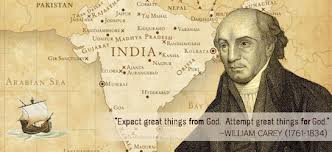
William Carey collegeCarey’s motto was “Expect great things from God; attempt great things for God.”


            Entirely self-taught, Carey impacted the emerging generation of Indian leaders that birthed the burgeoning modern democracy of India.  Serampore College was founded by Carey and his colleagues in 1818.  He produced six grammars of Bengali, Sanskrit, Marathi, Panjabi, Telugi, and Kanarese, and with John Clark Marshman, one of Bhutia.  He also translated the whole Bible into Bengali, Oriya, Marathi, Hindi, Assamese, and Sanskrit, and parts of it into twenty-nine other languages or dialects.  Scholars say that Carey significantly contributed to the renaissance of Indian Literature in the nineteenth century.


William Carey StampWhile an ordained preacher and a church planter, Carey was fascinated with all aspects of daily living.  In 1818 Carey founded two magazines and a newspaper, the Samachar Darpan, the first newspaper printed in any Asian language. He was the father of Indian printing technology, building what was then their largest printing press.  Carey was the first to make indigenous paper for the Indian publishing industry.  He brought the steam engine to India, and pioneered the idea of lending libraries in India.  Carey introduced the concept of a ‘Savings Bank’ to India, in order to fight the all-pervasive social evil of usury at interest rates of 36% to 72%.


Carey introduced the study of astronomy as a science, teaching that the stars and planets are God’s creation set by him in an observable order, rather than astrological deities fatalistically controlling one’s life.  He was the founder of the Agri-Horticultural Society in the 1820s, thirty years before the Royal Agricultural Society was established in England.  Carey was the first person in India to write about forest conservation. In 1823, he was elected as a Fellow of the Linnean Society of London, one of the world’s most distinguished botanical societies even today.  As Carey’s favorite flowers were lilies, he had the honour of having one (Careyanum) named after him.


william-carey graveHaving a strong social conscience, Carey was the first man to oppose the Sati widow-burning and female infanticide.  Sati was finally banned by the Government of India in 1829.  He also campaigned for humane treatment of lepers who were being burned or buried alive because of their bad karma.  The view at the point was that leprosy was a deserved punishment in the fifth cycle of reincarnation.


            Carey loved India and never returned home to England, dying in 1834 at the age of 73.  Near the end, he said: ““You have been speaking about William Carey. When I am gone, say nothing about William Carey-speak only about William Carey’s Saviour.”  My prayer for those reading this article is that we too would have the passion for learning and making a difference that William Carey once had.


Video: William Carey – A Candle in the Dark (click to view)


Ed processing

The Rev.  Dr. Ed Hird,

BSW, MDiv, DMin

Rector, St. Simon’s Church North Vancouver

Anglican Mission in the Americas (Canada)

http://stsimonschurch.ca

-an article for the June 2013 Deep Cove Crier

-award-winning author of the book ‘Battle for the Soul of Canada’

http://www.battleforthesoulofcanada.blogspot.com

p.s. In order to obtain a copy of the book ‘Battle for the Soul of Canada’, please send a $18.50 cheque to ‘Ed Hird’, #1008-555 West 28th Street, North Vancouver, BC V7N 2J7. For mailing the book to the USA, please send $20.00 USD. This can also be done by PAYPAL using the e-mail ed_hird@telus.net . Be sure to list your mailing address. The Battle for the Soul of Canada e-book can be obtained for $9.99 CDN/USD.
-Click to download a complimentary PDF copy of the Battle for the Soul study guide : Seeking God’s Solution for a Spirit-Filled Canada

You can also download the complimentary Leader’s Guide PDF: Battle for the Soul Leaders Guide

Friday, March 12, 2010

Reflection For a Fallen Sparrow - Gibson


Lakshmi* is a Christian Dalit woman I met in India years ago. Her gentle smile and deeply haunted eyes, caught in a photo, captivated me long before I made the trip.

Over there, despite the barriers between us—language, nationality, distance—we formed a connection I can’t explain.

During a Bible study in her Eastern Indian city recently, Lakshmi—lovely, wraith-thin, long-ill—sank to the floor, seized with convulsions. An even closer friend, the study leader, snapped a photo and emailed it to me.

Lakshmi lies on the floor like a fallen sparrow. Her tangled saree, a puddle of azure blue, splashes over the cement. Its colours blur—she writhes. Brown hands hover over her skeletal frame, entreating the monstrous motion to stop. Praying for healing, for Christ’s presence, for her not to swallow her tongue.

Someone inserts a silver spoon in her gasping mouth. Stainless steel. The irony doesn’t escape me. The spouse of a no-gooder, a wife-beater, Lakshmi was born impoverished. Lakshmi is still impoverished.

The shot slices me. I loathe it.

I have sent Lakshmi aid, as we rich Westerners often do when confronted with mountainous need. Rupees for a few groceries, a little medicine, a trip to the doctor perhaps. But my friend needs much more than I can give.

Jesus said that human need will never end. I’ve come to accept that to be a child of Adam is to suffer, to experience want along some lines—conscious or unconscious. Somewhere, there will always be a pain in need of a balm, a stomach that needs refueling, a child who cries alone.

Yes, God shows up, often miraculously banishing need. But sometimes people of faith die in fear and pain, while people of no faith whatsoever accept their end quietly and peacefully.

I’m so glad I don’t have to figure all that out. Glad too, that I’m neither judge nor savior.

What I know is precious little, but what I know is precious: Creator God, for whom our cosmos is but a speck of lint on his breast pocket—had he one—chooses relationship with us earthlings. Pursues us with love. Rewards faith. Meets our deepest needs for validation and inner peace. Sends the sweet companionship of his Holy Spirit – wherever we fall.

Life is but a dandelion puff, and I’ve had my fill of leaning on spiderwebs. Simple certainty remains: God cares for us and our needy friends in ways we cannot now comprehend. He allows us the blessing of lifting each other up, and not one of us deserves that.

We especially don’t deserve to benefit from what Christians prepare to celebrate: the death and resurrection of Jesus Christ. Yet his sacrifice, if we accept it, dissolves our sin, stamps us “forgiven,” and restores us to an eternity of opportunity.

Father in heaven, hallowed be thy name. Thy kingdom come, thy will be done on earth, as it is in heaven.

But oh, my God, hold tightly to my fellow fallen sparrow.

*not her real name

***

***
Kathleen Gibson author, faith and life columnist

this column was published in Yorkton This Week, March 10
and at www.kathleengibson.ca/sunnysideup,

Popular Posts