Saturday, November 03, 2018

The Promise of Home by Rose McCormick Brandon

Great confusion awaited the disciples. They were soon to encounter the chaos of the cross. They wouldn’t understand it. They expected Jesus to set up His kingdom and to rule with Him in a world dominated by His peace. They will someday, but they couldn’t see the vast river of time separating the cross and resurrection from the established Kingdom of God. 
                They, and we, are still waiting in the river. Jesus' message to them is His message to us today: 
Don’t let your hearts be troubled. Trust in God, and trust also in me. There is more than enough room in my Father’s home. If this were not so, would I have told you that I am going to prepare a place for you? When everything is ready, I will come and get you, so that you will always be with me where I am. John 14:1-3 NLT
                Sin and madness appear to rule. Events take place that cause our agendas to explode. Anarchy shrieks and lawlessness threatens. Scoffers deride Jesus’ message. They heap scorn on us who wait for His coming. 
               Don’t be discouraged by mockery. Jesus always keeps His promises. When the time is right – when our home in Heaven is ready, when the last soul kneels at the cross, when the Almighty gathers all the threads of history and ties them together – then, He’ll come and take us HOME.
                How the heart warms at the thought of home. A sanctuary. A place of relaxation. We can go shoeless, shirtless, pyjama-clad, hair undone, and feel no guilt. Because we’re home. 
               A much greater life than one of security and ease awaits us. Our true and eternal home. We may not have identified it as a longing for God’s house, but it’s been there, always, niggling at the soul, a nameless pining. A yearning for HOME. 
                 When the drapes open to let in today’s light ask, “Is it today, Jesus, that everything will be ready?” Perhaps not today, maybe not tomorrow, but some day, oh my, the curtain between heaven and earth will rend and a blast of heavenly light will release all His followers from the dust and carry us home. 
                Today, my Lord, let me ponder the heavenly home you’re preparing for me. It’s beyond my imagination, still, I can dream of it as I wait for You. 
***
Rose McCormick Brandon is the author of four books, including Promises of Home – Stories of Canada's British Home Children, plus dozens of personal experience pieces, devotionals, short stories and essays. Rose’s work has won awards in the personal experience and short essay categories. A member of The Word Guild and The Manitoulin Writers Circle, Rose and husband, Doug, summer on Manitoulin Island where her pioneer ancestors settled and the home of his favourite fishing holes. The rest of the year, they live in Caledonia, Ontario, near their three children and three grandchildren. 


Friday, November 02, 2018

"Silver-Haloed Clouds and a Golden Orb" by Peter A. Black


Publ Domain Photography
The air was cool and the sun bright, although beginning its descent of early evening, during my drive home one day. And the sky, reaching ahead of me towards the horizon in the West, displayed a colourful array of cloud clusters, from deep purplish black to grey, to violet, pink and blue. Many of them were bathed in striking, shimmering silver haloes. 

It was a sight that seemed just right for the crispness of the now cooler weather of fall. And yet, within twenty minutes, before the sun settled below the silhouetted landscape, it had taken on the appearance and visual warmth of a huge golden orb, characteristic of gorgeous Canadian sunsets. 


GoogleFree Italian Holiday
Had the sun really changed its colour? No. Had the clouds changed substance appreciably? Probably not. However, the position of the earth and the clouds had changed in relation to the sun. In practical terms, the earth did the moving, as it does in its daily revolutions and annually in its circuit around the sun, and so, things appeared different. This, of course, makes for the contrast between night and day.

Is that not how it sometimes is between us and THE Sun (God’s Son) of Righteousness?  Sometimes God and Christ may seem cold and distant to us, while at other times we view matters of faith more warmly, sensing that God is closer and Jesus is with us, and that life has a golden touch. 

In our seasons of life, as well as from day to day, may we be kept by the grace of God in proper relation to our Lord and recognize the silver lining of His mercy, when the cool of life’s evening begins to draw near.

On my journey towards home that day I was careful to keep my eyes on the road ahead, even while viewing the glories of the sky above. May we keep our spiritual eyes on Jesus who is the Way – that is, our path – to God, the Truth of God and the Life of God to us. Let us keep our gaze on Him, until we can view our lives and those around us in a kinder, warmer light – bathed in the gold of His grace.  

And, just as I reached home safely that night, may we each arrive safe at the eternal home prepared for us in the heavens (John 14:1-3). God grant us to be included among His faithful ones: “. . . for you who revere my name, the sun of righteousness will rise with healing in its rays. And you will go out and leap like calves released from the stall” (Malachi 4:2). The “sun of righteousness” is personified in Jesus, our Lord.

A Prayer:  Heavenly Father, Thank You for the glories of your handiwork written in nature and the skies, and for the parallels to our spiritual lives of which they serve to remind us. Amen. 
~~+~~

Peter A. Black is a retired pastor – well, sort of retired – and lives in Southwestern Ontario. He writes a weekly inspirational newspaper column, P-Pep! and is author of Raise Your Gaze ... Mindful Musings of a Grateful Heart, and Parables from the Pond – a children's / family book. ~~+~~
The above post was adapted from one of Peter's column articles published in October 2018.  The sunset pictures are courtesy of free online sources.


Thursday, November 01, 2018

HOW COULD I MISS THE OBVIOUS? by Eleanor Shepherd

           
I hate to admit it, but sometimes I can get so wrapped up in my problems and search frantically for solutions, without realizing the obvious resources that are right under my nose. It happened last week.

            The problem was that our son John’s wheelchair was broken and he was having no success in getting it fixed. We tried to figure out how we could help. He had contacted the company who usually did wheelchair repairs and they were not responding to his repeated messages. He was becoming overwhelmed with all of his obligations in addition to the concerns for the chair and was not well physically. I decided to take on the repair company and give them no peace until they responded to us. 

            So I started my campaign with a note to the person who had promised John several weeks earlier that she would undertake to arrange for his repairs. I was hopeful when, after a few days, I received a note apologizing for not responding to my earlier messages as she had been out of the office. She would call me the next day, if I could give her an appropriate time. I immediately responded telling her to call my anytime and giving her both my home and cell numbers. Then I waited all that day and no call came.


            The next day I tried again, calling both her office and cell numbers a few times and leaving messages as well as texting her. Still she gave no response. The following day I tried again. It seemed a bit bizarre for me to be calling from 540 kilometres (335 miles) away when John was there in the same city, but I would do whatever was needed to get some action. Thus I called again the next day, and I was beginning to become anxious.

            John had an important appointment and informed me that we would have to go in the broken chair, because he could not miss this meeting. He knew that chair was not safe but he saw no alternative. What could I say? Praying for his safety and worrying about the danger, I continue my efforts to get help for him. 

            As I puzzled and prayed, I suddenly realized that we had not sent our monthly prayer newsletter. Somehow in all of the activity at the beginning of the month I had forgotten to prepare it. This was a resource that had so often proved so helpful to us. That morning, when I concluded my time of prayer, I composed the prayer newsletter and outlined the challenges that we were facing in getting John’s chair fixed. I ran it by Glen and sent it out. 

            That is when things began to change, although I was not aware of it at the time. First I noticed that on the note that I had received from the person who was supposed to be helping John, there was a 1-800 number that I could call. I tried the number and immediately was connected with someone who told me that she would send a technician out to John early the next week. 

            Boldly (for me) I explained that would not do. He needed the chair fixed now and could not manage without it, so would have to have a loaner while it was being fixed. She arranged for the technician to come with a chair the following day.
            
            There were several other problems about the chair that I had mentioned in our letter and we received more responses that we have ever received to any of our prayer newsletters in the seventeen years we have been sending them out. People offered advice, support and helpful suggestions as well as assurances of their prayers.

            One response was what I considered a wink from the Lord. One of our prayer partners informed me that he felt that Lord was asking him to donate some money to John and told me the amount. I had not asked for money and had not mentioned it at all in our concerns about the chair. Not surprisingly for those who have seen God’s provision at work, when the chair was fixed in record time and the bill was presented, it was for the amount of this generous donation. 

                                                     Resources are available. We just need to use them.

Word Guild Award
2009
Word Guild Award
2011
Word Guild Award
2018

Tuesday, October 09, 2018

The Remarkable General William Booth - HIRD


By Rev. Dr. Ed Hird

Everyone nowadays loves the Sally Ann, the Salvation Army.  But such admiration was not always universal.  Violence and bloodshed was the order of the day when William Booth first reached out to the down-and-out in East London.  Few people today realize that one of the main purposes of the famous Sally Ann Bonnet was to protect the heads of wearers from brickbats and other missiles.  So many people used to buy rotten eggs to throw at the Sally Ann Bonnets that these rancid eggs became renamed in the market place as ‘Salvation Army eggs!’ In fact Janice’s great grandfather George Morgan was a longshoreman who volunteered as a body guard for William Booth, and Ed’s step-great grandmother Ensign Kate Lee Gathercole preached on the volatile streets alongside her good friend Catherine Booth.

In 1880, heavy sticks crashed upon the Salvation Army soldiers’ heads, laying them open, and saturating them in blood.  Mrs. Bryan (wife of the Captain) was knocked down and kicked into insensibility not ten yards from the police station, and another sister so injured that she died within a week.  During 1882, it was reported that 669 soldiers and officers had been knocked down, kicked or otherwise brutally assaulted, 251 of them being women and 23 children under 15.  In Hamilton, Ontario, the Salvation Army officers were initially ‘squeezed and mangled, scratched, their clothes torn and almost choked with the dust…’  In Quebec City, 21 soldiers were seriously injured, an officer was stabbed in the head with a knife, and the drummer had his eye gouged out. In Newfoundland, the Salvation Army was attacked with hatchets, knives, scissors and darning needles.  One night, a woman-Salvationist in Newfoundland was attacked by a gang of three hundred ruffians, thrown into a ditch and trampled on.  She managed to crawl out only to be thrown in again, as other women were shouting ‘Kill her! Kill her!

Ironically many police initially blamed the Salvation Army for being persecuted.  In numerous parts of England, playing in a Salvation Army Marching Band was punishable with a jail sentence!  During 1884, no fewer than 600 Salvationists had gone to prison in defense of their right to proclaim good news to the people in music and word.  In Canada alone, nearly 350 SA officers and soldiers served terms of imprisonment for spreading the gospel.  Despite the jail sentences and persecution, within three years the Army’s strength more than quadrupled!  The early Salvation Army ‘jailbirds’ described their handcuffs as heavenly bracelets.  It is little wonder that the Salvation Army eventually developed such a powerful prison ministry. 

One of William Booth’s mottoes was ‘go for souls and go for the worst!’  A local English newspaper The Echo commented that the Salvation Army largely recruited the ranks of the drunkards and wife-beaters and woman home-destroyers.  Many of us remember as children the song: ‘Up and down the City Road, In and Out the Eagle; That’s the way the money goes, Pop goes the weasel’!   Few of us realized that we were singing about the famous Eagle Tavern, just off City Road in London.   ‘Pop goes the weasel’ was cockney slang for the alcoholic who was so desperate for a drink that he would even pawn (pop) his watch (weasel).  Ironically, the Salvation Army bought the Eagle Tavern and turned it into a rehabilitation centre.  The Lion and Key public house in East London became known as ‘The Army Recruiting Shop’.  The landlord said, ‘My trade’s suffering, but you’re making the town a different place, so we can’t grumble.  Go on and prosper!’

William Booth shocked the world by conducting worship with tambourines and fiddles, instead of the traditional church organ.  To make up for the Salvation Army’s lack of church buildings, General Booth bought circus buildings, skating rinks, and theatres.
In response to such bold innovation, one newspaper columnist claimed in 1883 that ‘The Salvation Army is on its last legs, and in three weeks it may be calculated it will come to an end.’  In the beginnings, the Salvation Army was essentially a youth movement, with seventeen-year-olds commanding hundreds of officers and thousands of seekers.  Archbishop Tait of Canterbury was so impressed by this youth movement reaching the poor, that he set up a commission which unsuccessfully tried to adopt the Salvation Army as an Anglican society.

By persevering, the Salvation Army began to earn respect from both the churched and the unchurched, and from all segments of society.  Even Queen Victoria at Windsor Castle sent the following message: ‘Her majesty learns with much satisfaction that you have with other members of your society been successful in your efforts to win many thousands to the ways of temperance, virtue, and religion.’  By their persevering in reaching out to the poor, William Booth and the Salvation Army became known as the champions of the oppressed.    Like no other individual in nineteenth-century England, General Booth dramatized the war against want, poverty and destitution. 

It was not by accident that William Booth’s message became linked with ‘soup, soap, and salvation’!  Every Salvation Army soldier was taught from the beginning to see themselves as servants of all, practicing the ‘sacrament’ of the Good Samaritan.  The famous preacher Charles Spurgeon once said, ‘If the Salvation Army were wiped out of London, five thousand extra policemen could not fill the place in the repression of crime and disorder.’ In recognition of his incalculable impact on the poor, William Booth received on June 26th 1907 the degree of Doctor of Civil Law from the University of Oxford.
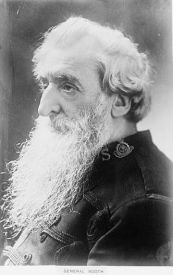
William Booth throughout his life showed remarkable creativity and courage.  He was one of the world’s greatest travelers in his day, visiting nearly every country in the world.  Even at age 78, General Booth was described as ‘…a bundle of energy, a keg of dynamite, an example of perpetual motion.’  A keen observer of the international scene, Booth in 1907 prophesied Japan’s technological rise, saying: ‘It is only a question of time when her industries will be tutored with the most expert direction, and packed with the finest machinery taken from all nations of the world, and I do not see what can prevent her producing the finest articles at the cheapest possible price.’

His fellow soldiers saw Booth as a man to follow to their death, if need be.  William Booth was truly a spiritual father to the fatherless.  His son Bramwell held that his Dad’s greatest power lies in his sympathy, for his heart is a bottomless well of compassion.  A Maori woman described William Booth as ‘the great grandfather of us all – the man with a thousand hearts in one!’  Mark Twain said, ‘I know of no better way of reaching the poor than through the Salvation Army.  They are of the poor, and know how to get to the poor.’

I give thanks for General William Booth and the Salvation Army who have shown the true Father’s Heart to so many hurting, fatherless people.

p.s. To hear General Booth speak, just click on the following link.

The Rev. Dr. Ed Hird, BSW, MDiv, DMin
-co-author of For Better, For Worse: discovering the keys to a lasting relationship


Sunday, October 07, 2018

Christian neurosurgeon Michael Egnor: Is free will a dangerous myth? - Denyse O'Leary


The belief that there is no free will is a much more dangerous myth, he writes, at Mind Matters Today:

There are four reasons to affirm the reality of free will against denial by materialist determinists. Two reasons are logical, and two are scientific.
…
4. While scientific experiments do not entirely settle the matter, an objective review of the neuroscientific evidence unequivocally supports the existence of free will. The first neuroscientist to map the brains of conscious subjects, Wilder Penfield, noted that there is an immaterial power of volition in the human mind that he could not stimulate with electrodes.

The pioneer in the neuroscience of free will was Benjamin Libet, who demonstrated clearly that, while there is an unconscious material predisposition to acts as shown by electrical brain activity, we retain an immaterial “free won’t,” which is the ability to veto an unconscious urge to act. Many experiments have followed on Libet’s work, most of which use fMRI imaging of brain activity. They all confirm Libet’s observations by showing what is at most a loose correlation between brain activity and volition (for example, nearly half the time the brain activity that precedes the act is on the wrong side of the brain for the activity to determine the will)—the looseness of correlation being best explained as evidence for libertarian free will.

Modern neuroscience clearly demonstrates an immaterial component to volition. Harari is wrong about free will. It is not a myth. Free will is a real and fundamental aspect of being human, and the denial of free will is junk science and self-refuting logical nonsense. More.
Egnor adds that denial of free will, in a culture of pervasive surveillance, is the straightest road to totalitarianism.

Michael Egnor is a neurosurgeon, professor of Neurological Surgery and Pediatrics and Director of Pediatric Neurosurgery, Neurological Surgery, Stonybrook School of Medicine

Also by Michael Egnor Knowledge is power, sort of… If that’s ALL knowledge is, the resulting science is bound to be limited, says Michael Egnor . If you are trying to predict the course of a cannonball, Newtonian mechanics are adequate. If you are trying to understand the mind of the guy who fired the cannon, you need to look much deeper.

See also at MMT: Deep Learning won’t solve AI AlphaGo pioneer: We need “another dozen or half-a-dozen breakthroughs.” Hassabis: "AlphaGo doesn't understand language but we would like them to build up to this symbolic level of reasoning — maths, language, and logic.

Are sex robots a cure for loneliness? Maybe, in a culture where people see themselves as machines. Nancy Pearcey, who is the author of Love Thy Body: Answering Hard Questions about Life and Sexuality, reminds us that the most popular metaphor for the universe today is a vast machine. and

Remember those awful Seventies TV ads? The new “attention economy” killed that kind of advertising. But what now? One way of describing the change is that we now live in an attention economy rather than a captive time economy, so far as advertising is concerned.

Tuesday, October 02, 2018

"The Difference – a Tiny Moment" by Peter A. Black


They played basketball together in highschool and regional tournaments. And,
TVRA-South-East-boys. Highschool successors 2.5 decades later.
Credit: hometownplay.ca
for some years after they’d established themselves in their careers and were raising families, they still got together for friendly old-guy games.

Eventually they got wise, as their aching knees told them it was time to quit their favourite sport – after all, they’d soon be entering their middle-age years. Instead, they made an annual pilgrimage into the USA for a concert, since they shared a common liking for a particular artist.

They used to ride down on motorcycles. One of the group’s families owned a Harley Davidson dealership, and those buddies who no longer owned a bike would rent one for the weekend. In more recent years they’d travel in a couple of trucks.

A month or so ago two of those friends and their families got together to celebrate one of the youngsters’ birthdays. The boy’s dad was an avid Harley owner. It was an enjoyable time by the pool with family and friends.
Three mornings later my wife’s mobile sounded. It was a text message. “Good Morning . . . Last night was not a good night. . . .” It went on to say that Brent was killed in the early evening, near Belmont, Ontario, and that his fellow biker was in a London hospital with life-threatening injuries.

Credit: Courtesy of CTV. 
One bike seems partly under the other & partly in the ditch.
These biking buds were devastatingly struck while riding their motor-cycles—Brent on his beloved Harley. As of my writing the full story has not been given in the media, but it appears that an SUV coming from the opposite direction, suddenly, without warning, made a left turn and plowed into both riders.
A tiny moment in time. Fractions of a second. Mere metres. The difference between life and death for one man, and for the other the difference between prime-of-life strength and serious injury, possibly with life-altering effects. A tiny moment spelling the difference for both men: between a welcome home and supper together with spouses and kids, and heartbreaking tragedy.

Our son Chris and his wife and family were the friends who hosted Brent’s youngest son’s eleventh birthday celebration only two days before that fatal accident. They grieve the loss of their friend and grieve for his wife and children. They will surely be concerned about the injured motorcyclist and his family. I grieve too. And I pray—even for the driver of that SUV.
The biblical scriptures say that after death we are to give account to God (see Hebrews 9:27). We may not know just when or how our appointment with death will come. However:

We have this moment.

It only takes a tiny moment to invest our faith in the Lord Jesus Christ, God’s Son our Saviour, and to apply to our hearts and lives the sacrifice He made in our behalf to purchase our redemption. The Saviour says,

“. . . whoever hears my word and believes him who sent me has eternal life and will not be judged but has crossed over from death to life” (John 5:24 NIV2011).

A tiny moment . . . an eternal difference!

~~+~~

Peter A. Black is a retired pastor – well, sort of retired – and lives in Southwestern Ontario. He writes a weekly inspirational newspaper column, P-Pep! and is author of Raise Your Gaze ... Mindful Musings of a Grateful Heart, and Parables from the Pond – a children's / family book. ~~+~~


Monday, October 01, 2018

Unlimited Thanksgiving by Eleanor Shepherd


            The month of October is when we celebrate Thanksgiving in Canada. As the date approaches, I often reflect on the many reasons that I have to be thankful. 

            I realize that there is much cause for concern, frustration and even fear as we listen to the news or pickup newspapers and magazines and hear of many things going on in our world that do anything but cause us to give thanks. However, I have concluded that for our own psychological and spiritual well being, we need to choose to focus our attention at times on our blessings rather than those things that disturb us and which we can change only with great effort. I am not saying that we should not try to make a difference, but I think we are more capable of doing that, if we take the time to consider what God has done for us and is currently doing in our world that give us cause to rejoice and praise Him. From a place of strength then, we can employ the resources He provides to take positive action to stem the negative tide. 


            All this is to clarify that when I lift my heart in thanksgiving, I am not ignoring the challenges in our world but rather garnering support to combat those ills I can.  

            I find the place where thanksgiving overflows spontaneously is in one of my favourite places – the sanctuary where I worship regularly on a Sunday morning, with my church family.  As I sat there yesterday morning, with one granddaughter on each side of me, the youngest blissfully napped as the warm voice of the preacher reminded us of the truths of God’s unlimited love and care, even when we mess up, as he spoke from the book of Jonah. 

            
On my other side, sat my older granddaughter, drawing pictures on sheets of paper that Grandpa had offered her. At nearly seven, she appeared to be unaware of what was being said, but from her questions during those quiet times when we have opportunities to chat together, I know that she is also listening. I chuckled to myself as I saw her enter enthusiastically into the praise choruses, clapping her hands in sync with her best friend standing beside her. The two of them are a beautiful reflection of our congregation – one with a pale face and blond curls and the other with an ebony face and black curls. From the time they greet each other at the church on Sunday morning until they leave the building with their families after coffee time and practices the two of them are inseparable.   

            As well as being at the church with my own family, I also give thanks for my church family. Many of them have become dear friends as together we have prayed for one another, during the challenges of sickness, death, separation and divorce, loss of employment and difficult educational decisions, as well as life altering accidents, births, marriages and the daily conundrums of living that we just need to share with someone. 


            However, my gratitude is not limited to those who share my particular world-view either. Perhaps it is related to aging, I am not sure, but I have found that the more I learn about people and the contributions that they make to the lives of others, the more I appreciate them, whoever they are. I have come to discover the truth of the well loved hymn, “There’s a Wideness in God’s Mercy,” for I am finding that there are many who may never enjoy the sacred time in a church sanctuary that I do, yet are still touched by the presence of God and respond to His loving presence by doing kind things for others. When I see what they do, I give thanks to God. He is doing more than we can ask or imagine and that is good reason for thanksgiving.
Word Guild Awards
2018
Word Guild Awards
2011
 
Word Guild Awards
2009
Eleanor Shepherd, an award-winning writer is a retired Salvation Army officer and has published over 100 articles internationally. A speaker at conferences, in Canada, the  USA, France, Belgium, Switzerland, South Africa, Australia, Haiti and Jamaica, her stories appeared in Hot Apple Cider and Christmas with Hot Apple Cider.  Her book More Questions than Answers, explains her style of evangelism by listening

Popular Posts