Monday, December 23, 2019

A *Swan-Song* Christmas — By Peter A. Black


The piece below is a modified edition of my final article that concluded my weekly column – P-Pep! that ran for 23 years.

Have you ever performed a ‘swan song’? 
Credit: GetDrawings.com 
Let’s say, an operatic singer begins having problems with her voice and her vocal range isn’t quite what it used to be. She’s still a wonderful, experienced artist. However, she’s aware that it takes much more energy than before to reach the upper extremities of her range, and she has to exert greater concentration to hold them steady.
Since she’ll not be getting a new voice this side of heaven, she decides to retire, figuring that she’d better quit while still at the peak of her profession.

The peak can be a perilous place, because, to where do you go from the peak? By quitting she would avoid the embarrassment of her voice cracking in performance and disappointing her fans, or having music critics carping that it’s time she quit.
And so, she plans a retirement recital featuring a selection of her best-loved repertoire. That performance will be her “Swan Song.” 

Credit: webiconspng.com
Perhaps your swan song was a speech you gave upon retirement from your workplace or business, or when moving on to new opportunities.
I’ve ‘swan-songed’ on a number of occasions. Most occurred when I was leaving pastoral charges to go to another. At the final service, in addition to my final sermon and expressions of gratitude to the congregation and so on, my wife and I would sometimes be asked to sing.

Those were usually bittersweet occasions. In the earlier days it meant tearing our sons away from their friends and school chums and the familiar haunts where they’d spent some of their growing-up years. The sweetener, though, was a sense of adventure and eagerness, despite trepidation, for taking on new challenges.
It’s not uncommon for some fun-poking at swan-song events, as emcees and colleagues reminisce, presenting generous tributes of appreciation, or engaging in ‘hot-roasting,’ as they recall comedic incidents and oddities of the departing ‘swan.’ Mild roasting was not uncommon in my case, since there’s ample idiosyncratic fodder to draw from.

I began writing this inspirational column, P-Pep! during August of 1996 in The Watford Guide Advocate. It has continued throughout the process of amalgamation with several other papers and their rebirth into the Lambton Middlesex Standard
We’re not in heaven yet; however, it’s time for a new writing voice and a new column name. And now, after twenty-three years P-Pep! column will be gone. Perhaps the publisher will continue making this space available for someone else to – as it were – sing the praises of our Lord Jesus and offer an elevated focus to encourage our readers along their respective life pathways.

I’m still singing vocal music – mostly sacred. My voice cracks . . . a lot, and yet I’m grateful that I have health and strength still to sing and play, speak in services and visit the sick, and am blessed that my wife May shares in many of these pursuits. For now, I’ve been drawn back into a pastoral role in a country church and community ministry.
I’m grateful to the publisher for accepting my submissions and am especially grateful to Vicki MacKenzie for her skill, care and friendship; she has formatted P-Pep! throughout these many years. I’m grateful too, for you, the reader. Without you, P-Pep! would have been pointless!

As I go ‘swanning’ out of this space I pray that you will all be blessed with a joyous Christ-filled Christmas, and with a New Year that, along with its challenges, will include much cheerful encouragement, with grace and peace through Jesus our Lord.
Peter.
~~+~~

So it has been and so it is.
To all of our TWG authors blogspot contributors and readers and your loved ones: May the Blessings of God in Christ Jesus our Lord be multiplied to you this Christmastime and throughout the Coming Year, with grace and peace, through the Prince of Peace.
Our Place

Amen.

~~+~~


Peter is author of Parables from the Pond (Word Alive Press) and Raise Your Gaze ... Mindful Musings of a Grateful Heart (Angel Hope Publishing). 


~~+~~


Saturday, December 14, 2019

What I want for Christmas

"What do you want for Christmas?"

That's a common question at this time of year. Over the years my answers have changed a good deal. As a child, toys and games were at the top of my wish list. Gradually, I out grew toys, but the right kind of game still holds a measure of attraction.

So what do I want this year?

That question reminds me of that children's song "All I want for Christmas is my two front teeth."

No. I don't need front teeth. These old incisors still work very well. Thank you.

So what's on my wish list?

Log Drive Cafe, carol sing, Ottawa, ON
 The short answer is time. Yes, you heard right I   want time. Time—that precious commodity.   Everyone is running short of it. I guess that's       why I find it so valuable. How about you?

 Last night I spent a wonderful evening at a carol   sing. About thirty people gathered in a spacious   living room setting and sang their hearts out. My   oldest son, Timothy, played a leading role   throughout. At one point youngest son, Joshua,   joined him for a rousing duet rendition of "Mr.   Grinch!"

 What a fabulous time! In that moment this father's Grinchy heart grew by at least two sizes—maybe
Two sons performing Mr. Grinch
three.

After a break for coffee and hot apple cider everyone gathered again and sang carol after carol about Jesus and his birth. By the time we wrapped up with "Away in a Manger" and "Silent Night" the Saviour had joined us. He was in that room just as surely as he was in that stable some 2,000 years ago.

That's what I wanted—what my soul craved. Some time. Time with Him.

So what do I want most for Christmas?

Some moments—some precious moments of time with family. And with Jesus. Christmas isn't about what's under the tree. It's about who gathers around it. And about the One who for my sake hung on a tree.

I just want some time. Some time with Him.

Wishing you and your family a wonder-filled time this Christmas.

David Kitz
Chair of The Word Guild
https://davidkitz.ca/


Wednesday, December 11, 2019

Ponderings Before Christmas


an embroidered ornament


As we approach Christmas, I remember a former pastor giving the children’s sermon and sharing the story of Mary and Joseph on their way to Bethlehem. Mary, pregnant with who we know to be the Saviour, and Joseph, closing up his shop and preparing for the journey. Our pastor told about the shepherds in the field and the astrologers (wise guys who study stars) trying to figure out that new star. And each week the figures of those key players were moved forward a little closer to the ultimate destination.

It would have been a long journey on foot for the couple. How long did it take for them to travel all that way? Did Mary ride all the way or walk sometimes too? Did Joseph wear sturdy sandals? And what did they carry with them besides a change of clothes and swaddling cloths for the baby, once it arrived. They would know, surely, that the baby would come before their return to Nazareth.

They were called by census to go. It mattered not that one had to close up his shop for weeks, or that a woman was due to have a baby. The census was called and there were no excuses. No begging off or evading it. They had to show up.

If we look into biblical history, we glean more details of the travelling time and expectations. What was it really like? How did it feel for them?

Artists fill in many details for us, how it might have looked for Mary and Joseph approaching the city, perhaps at nightfall. How did the stable look? When the shepherds got the news out on the hillside, it was probably frightening on a dark night. How many visitors came to the stable? And, indeed, how did that manger look with a newborn human baby in it?

We can imagine all we like how it was for the people in that time and place, receiving the news of a Saviour. But perhaps we could focus more on our hearts and our preparation. How does it feel to know salvation is coming? How does one prepare for such a thing? From a small baby no less, and a Father in heaven who orchestrated it all?

We might well ask, as Christina Rosetti wrote in her famous poem in the late 1800s, “In the Bleak Midwinter,”
“What can I give him, poor as I am?”
And as the poem (now to a tune) concludes,
Yet what can I give Him: give my heart.”

Those words are still good today. Yes, that is our part for this Christmas, to give our heart.


Our creche, waiting for the baby

Carolyn Wilker


 Carolyn is a writer, editor and storyteller from southwestern Ontario, where she blogs, writes a newsletter for writers and helps people tell their stories. And spends time with family and friends.


Monday, December 09, 2019

Katharina Luther: Reformation Firestarter -HIRD


By Rev. Dr. Ed & Janice Hird
-an article for the December 2019 Light Magazine
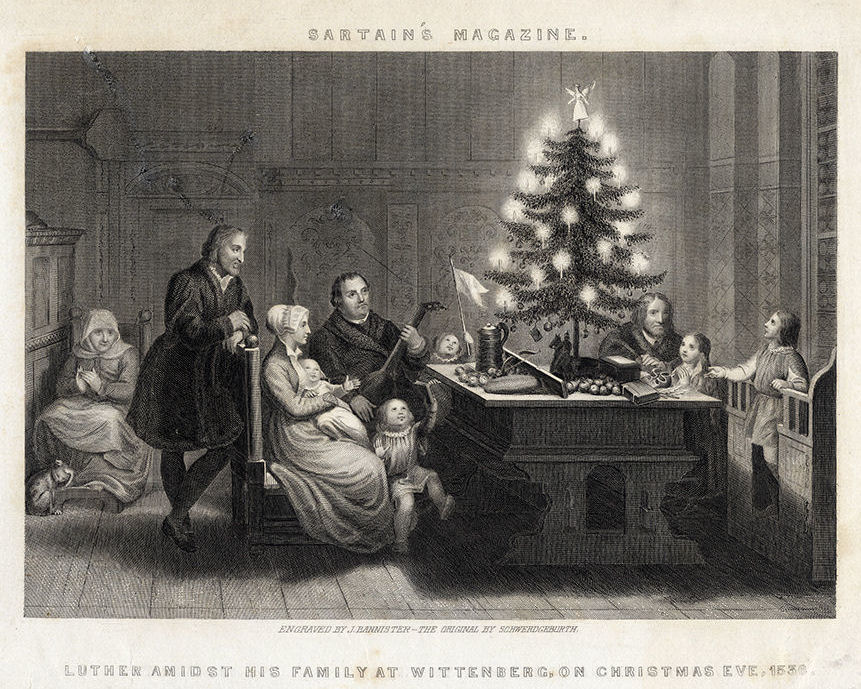
Image result for martin luther christmas tree
Martin Luther & his wife Katharina dearly loved Christmas.  Tradition even credits them with having the first Christmas tree. On this 502nd anniversary of the Reformation, it is worth remembering that Luther’s marriage revolution allowed pastors to marry for the first time in over 500 years.  Marriage and family went from being second-best to something to be celebrated.  Many priests’ housekeepers with children were promoted to become legal clergy wives. Some suggest that allowing clergy marriages was even more definitive than the doctrine of justification by grace through faith.
Luther not only endorsed pastors marrying, but took the plunge himself, marrying a runaway nun.  King Henry VIII of England famous for marrying and divorcing several wives ironically accused Luther of starting the Reformation out of sheer lust.  In 1527, Henry VIII sponsored a stage play mocking the marriage of Luther and Katherina — accusing them of spiritual incest in taking a monastic sister to bed.  A widely circulated pamphlet spoke about the married Kate Luther: “Woe to you, poor fallen woman” and “your damnable, shameful life”.
Luther’s bride, Katharina von Bora, was sent at age 5 to a nunnery by her widowed father when he remarried to a widow with her own children.  In 1524, the year after Katharina escaped the convent, Luther published a pamphlet: A Story of how God Rescued an Honorable Nun. This told the true story of a young woman Florentina who was shipped off to a convent at age six and flogged and imprisoned in a convent prison cell when she tried to leave.  He also wrote about “children...pushed into the nunneries’ by ‘unmerciful parents who treated their own so cruelly.”
When these nuns tried to leave, they would be arrested and even beaten.  Luther commented, “...no vow is valid unless it has been made willingly and with love.”
Katharina and eleven other nuns escaped on Easter Eve, one of the few nights they would be permitted to stay up late.  Leonhard Köppe delivered herring in barrels to the Nimbschen convent, in exchange for twelve nuns hidden in and among the herring barrels. It has been described as one of the most stunning jail breaks in history.  A year later, a man elsewhere in Germany was executed for aiding a similar escape.
Luther’s job was to find husbands for the nuns.  Kate had romantically fallen for Jerome Baumgartner who never returned back to Wittenberg for her as he had promised.  Luther wrote Jerome on October 12th, 1524: “If you want to hold on to your Kate von Bora, you better hurry up before she is given to some other suitor who is on hand. Until now she has not gotten over her love for you.  And I would be very pleased if the two of you were united with one another (in marriage).” Jerome’s parents married him off instead to a wealthy 14-year old heiress.
Luther then tried to marry Kate off to Dr Kaspar Glatz.  Kate turned in desperation to Luther’s colleague Nikolaus von Amsdorf, saying she would accept a marriage proposal from Amsdorf or Luther, but not from Glatz.  He met with Luther, saying: “What the devil are you doing, trying to coax and force the good Kate to marry that old cheapskate whom she neither desires nor considers with all her heart as husband?”  Luther responded: “What devil would want her then?  If she does not like him, she may have to wait a good while for another one!”
After Luther asked Katharina what he was to do with her, she said: “You could marry me yourself.”  This shocked Luther, as he saw himself over the hill at age 42, as well as likely to be martyred.  He decided to ask his dad Hans Luther who recommended that he settle down and give him some grandchildren.
Luther later commented: “I never loved Kate then for I suspected her of being proud (as she is), but God willed me to take compassion on the poor abandoned girl.”  Upon Katie’s finding out that she would marry Martin, she prayed: “Now I shall no longer be Katharina, runaway nun; I shall be the wife of the great Doctor Luther, and everything I do or say will reflect upon him...It is like an assignment from God.  God, keep me humble.  Help me to be a good wife to your servant Doctor Luther.  And perhaps, dear Father, you can also manage to give me a little love and happiness.”
After marrying, the Luthers made the former Augustinian Black Cloister their home.  Luther, as a former confirmed bachelor, commented: “There is a lot to get used to in the first year of marriage.  One wakes up in the morning and finds a pair of pigtails on the pillow which were not there before.”  Katherina also shockingly put up curtains and washed his bedsheets.  Luther commented: “Before I was married, the bed was not made for a whole year and became foul with sweat.”
Katharina was a true biblical Martha, always working and practically serving her family.  Drawing on her nunnery experience, she was up at 4 am each morning, causing Luther to call her the Morning Star of Wittenberg.  She provided a financial and emotional stability in Martin’s life, that helped him be more grounded.  Martin, being an ex-monk, refused to charge his students for attending his lectures or be paid for his books.  He also was radically generous, even cosigning expensive loans on which others defaulted.  Fortunately, Katharina was a gifted businesswoman, who turned their home into a profit-making hotel for students and others. Luther commented: “I am rich. God has given me my nun and three children: what care I if I am in debt, Katie pays the bills.” With forty rooms alone on the ground floor of her Black Cloister home, Kate functioned as a Protestant abbess.  She was busy with “a motley crowd of boys, students, girls, widows, old women, and youngsters.”
Katharina, with her sheer energy, gave Martin the local base for a global reformation.  In a 1535 letter, Martin wrote that his Lord Katie was busy planting crops, preparing pastures, and selling cattle.  Kate became gardener, fisher, fruit grower, cattle and horsebreeder, cook, beekeeper, provisioner, nurse, and vintner.  Katharina also served as Luther’s publishing agent. He entrusted to her the task of printing and distributing his prolific writings.
Over time, they developed a very romantic marriage, as Luther commented: “Kiss and rekiss your wife....A married life is a paradise, even when all else is wanting.”  He began to write about Kate as  ‘my true love’ and ‘my sweetheart’.
 In Table Talk, Luther commented, “I would not trade my Kate for France and Venice for three reasons:
(1) Because God has given her to me and me to her.
(2) I have seen time and again that other women have more faults than my Kate.
 (3) She is a faithful marriage partner; she is loyal and has integrity.”
 “Kate”, Martin said, “you have a god-fearing man who loves you. You are an empress; realize it and thank God for it.”  This Christmas, may each husband thank God for the empress in his life.  Our marriage and families are better today because of Kate and Martin Luther, a global firestarter family.
Rev. Dr. Ed and Janice Hird
Co-authors of the new BlueSky novel, available in local bookstores and on Amazon
Image result for martin & katharina luther

Saturday, December 07, 2019

Even "vision of hell" near-death experiences can have positive effects," say researchers. - Denyse O'Leary

As a psychologist pointed out last year, there is no simple way to just dismiss near-death experiences (NDEs). Explanations that focus on the chaos produced by oxygen deficiency, endorphins, etc., don’t really work:
For example, oxygen deficiency usually results in chaotic hallucinatory experiences and is associated with confusion and memory loss. NDEs are completely unlike this. They are serene, structured, and well-integrated experiences. In theory, in NDEs people could have a very low level of brain activity which is not picked up by EEG machines. On the other hand, it seems very unlikely that such a low level of brain activity could produce such vivid and intense conscious experiences. If there was any conscious experience, it would surely be dim, vague, and confused. In NDEs, by contrast, people often report becoming more alert than normal, with a very clear and intense form of awareness.
STEVE TAYLOR, “NEAR-DEATH EXPERIENCES AND DMT” AT PSYCHOLOGY TODAY (OCTOBER 12, 2018)
A more recent hypothesis attributes NDEs to psychedelic chemicals that are naturally produced by the brain (DMTs) but, as Taylor notes, the pattern of evidence is weak.
Careful researchers, coming from a variety of perspectives, have now sifted hypotheses over several decades. Whatever is happening with NDEs won’t yield to a simple explanation tossed off by, say, an internet skeptic at his blog.
Thanks to modern medical interventions, the experiences are not even rare:
Up to 25 per cent of people who almost die report a near-death experience. These usually involve sensations of zooming through a tunnel towards a light. Many also feature replays of the person’s life and reunions with dead loved ones.
GRAHAM LAWTON, “WHY ALMOST EVERYONE BELIEVES IN AN AFTERLIFE – EVEN ATHEISTS” AT NEW SCIENTIST

So the issue now isn’t whether anything is happening but what exactly is happening.
But then what about the small proportion of near-death experiences that are distressing? We are told by the International Association for Near Death Studies, Inc. that most near-death experiences (NDEs) recorded in the literature are “dominated by pleasurable feelings such as peace, joy, and bliss.” The distressing ones, by contrast, have been described as “dominated by distressing, emotionally painful feelings such as fear, terror, horror, anger, loneliness, isolation, and/or guilt” (2017). One researcher classifies as many as 15 percent of NDEs as hellish (Blackmore, Consciousness: An Introduction, 2004: 362).
What are these bad experiences like? In The Near-Death Experience: A Reader (1996), Bruce Greyson and Bush studied fifty reports of distressing NDEs, including “an acute awareness of nonexistence or of being completely alone forever in an absolute void. Sometimes the person received a totally convincing message that the real world including themselves never really existed.” A few such reported experiences have included hellish imagery. Some also included a sense of personal torment or negative judgment.
These experiences can be mapped onto specific psychological or religious templates but here are some general observations from the literature:
  • Distressing NDEs are comparatively rare and individual examples may not necessarily form a pattern:
As a result, what we know about frightening NDEs must be considered less certain than virtually any other aspect of NDEs.
JEFFREY LONG,, “FRIGHTENING NDES” AT NEAR-DEATH EXPERIENCE RESEARCH FOUNDATION
Given that estimates of distressing NDEs range from 1% through 15%, different interpretations and classifications may be at work.
For example, some people may be distressed simply by the fact that they had a near-death experience, even if it was benign, because it means that they had a brush with death (Long). In addition, psychotic episodes or the aftermath of drug abuse may be misclassified as “hellish” NDEs but the experiencer was not in fact near death. (Long).
  • People who had a distressing experience may be proportionately less likely to report it than people who had a pleasurable experience.
It is often difficult for NDErs who had a pleasant experience to share their NDEs. It is understandable how hesitant an NDEr might be to share an experience that was frightening, or even terrifying. NDErs experiencing hellish NDEs are likely aware that they risk inviting negative judgments from others due to the content of their NDEs.
JEFFREY LONG,, “FRIGHTENING NDES” AT NEAR-DEATH EXPERIENCE RESEARCH FOUNDATION
The experiences can be mixed rather than wholly negative:
Many NDEs are not purely frightening, but have parts that are both frightening and pleasant. When NDEs have both frightening and pleasant components, it is more common for the frightening part to occur first. For these NDEs, they eventually transition into the later, and usually longer, part of the NDE containing the more typical pleasant experience elements.
JEFFREY LONG,, “FRIGHTENING NDES” AT NEAR-DEATH EXPERIENCE RESEARCH FOUNDATION
Research to date suggests no fixed pattern as to who might be expected to have distressing experiences except that persons who attempted suicide are overrepresented. That could testify to the experiencer’s general state of mind:
Prior studies of frightening and hellish NDEs have established that it is wrong to assume that ‘good people’ have pleasant NDEs and ‘bad people’ have hellish NDEs. In spite of the findings of these prior studies, this erroneous stereotype persists. This stereotype could greatly limit the desire of those experiencing hellish NDEs to share them.
JEFFREY LONG,, “FRIGHTENING NDES” AT NEAR-DEATH EXPERIENCE RESEARCH FOUNDATION
  • Contrary to what we might expect, distressing NDEs often have a positive effect: “Someone who had a lifelong pattern of using emotional isolation to avoid being rejected by others, may have a distressing NDE of the eternal void, in which he realized that profound, endless isolation is not what he really wants.” (International Association for Near Death Studies, Inc.) Some people reconnect with their religion or spirituality or improve their health choices as a result. For example,
It’s remarkable that one single experience can have such a profound, long-lasting, transformational effect. This is illustrated by research showing that people who have near-death experiences following suicide attempts very rarely attempt suicide again. This is in stark contrast to the normal pattern—in fact, a previous suicide attempt is usually the strongest predictor of actual suicide.
STEVE TAYLOR, “NEAR-DEATH EXPERIENCES AND DMT” AT PSYCHOLOGY TODAY (OCTOBER 12, 2018)
Ceasing attempts at suicide is, however, consistent with the common finding of profound changes in outlook:
Survivors often believe they have been to another realm. They lose all fear of death and become convinced that some aspect of their consciousness will survive it – although they struggle to say what, falling back on vague notions such as spirit and soul. Even people who were convinced that death is final often come back from a brush with it as believers in an afterlife.
GRAHAM LAWTON, “WHY ALMOST EVERYONE BELIEVES IN AN AFTERLIFE – EVEN ATHEISTS” AT NEW SCIENTIST
So, all parties agree that we don’t know very much about near-death experiences except that, even if they are distressing, they are life-changing. Researchers now focus on trying to understand them rather than explain them away.

Further reading: Do near-death experiences defy science? NDEs do not defy science. They sometimes challenge human senses, which are based on our biology. For example, if the human eye’s usual limitations were not a factor, previously unknown colors—which we KNOW from science to exist—might be perceived.
and
Why medical scientists take near-death experiences seriously now Today, we know much more about what happens to people when they die—and what we are learning does not support materialism. Near-death experiences are generally seen as real, even among hardcore skeptics and research focuses on how to account for them.

Reprinted from Mind Matters News

Popular Posts